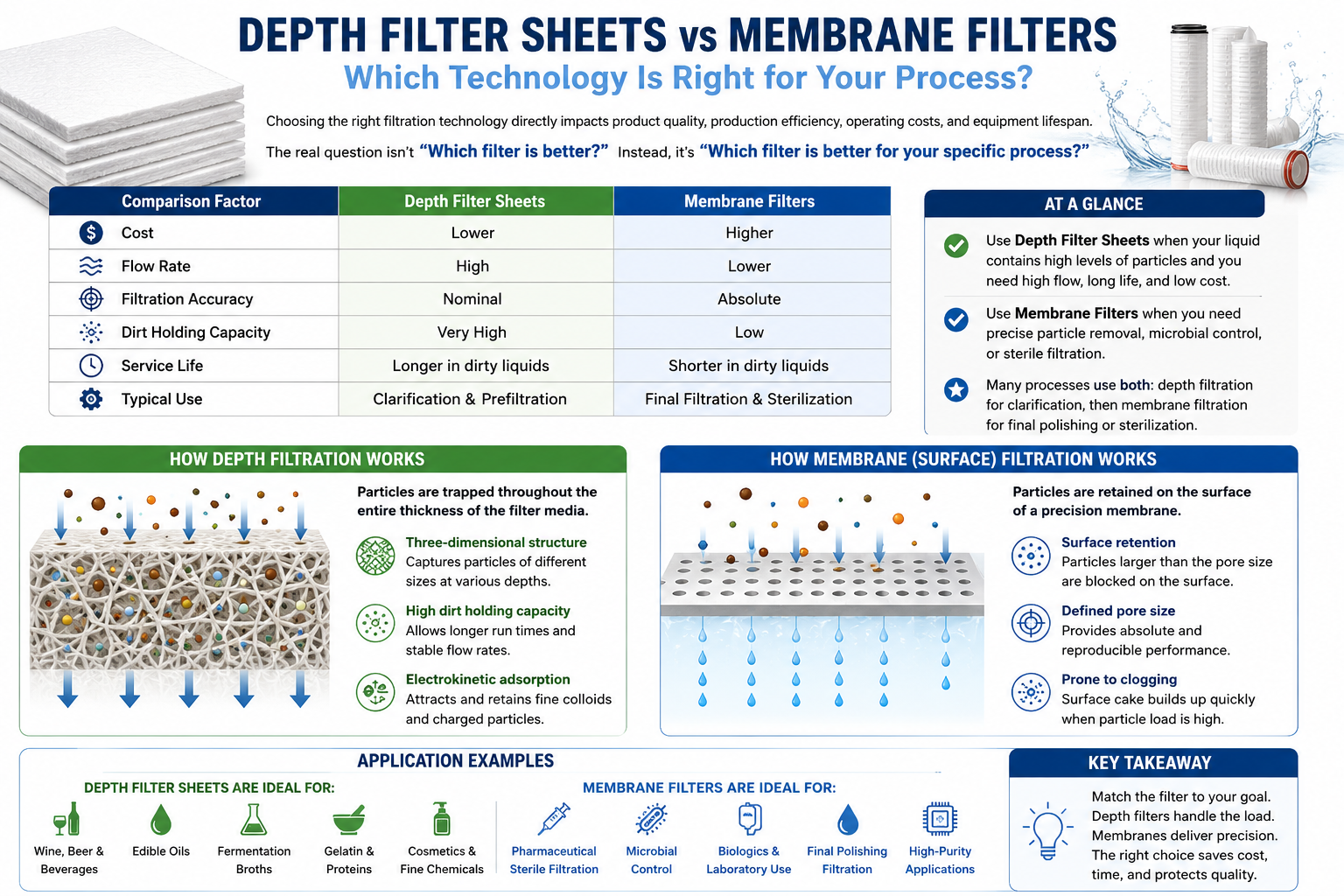
Technology Is Right for Your Process?
Choosing between depth filter sheets and membrane filters is one of the most important decisions in any liquid filtration process. Whether you’re producing wine, beer, edible oils, pharmaceuticals, cosmetics, or specialty chemicals, the filter you select directly affects product quality, production efficiency, operating costs, and equipment lifespan.
Many engineers assume that a membrane filter always delivers better filtration because it has a defined micron rating. While membrane filters indeed provide highly accurate particle retention, they are not always the best solution. In fact, using a membrane filter on liquids with high particle loads often leads to rapid clogging, increased differential pressure, frequent replacements, and higher production costs. On the other hand, depth filter sheets excel at handling large contaminant loads while maintaining high flow rates, making them the preferred choice for clarification and pre-filtration in many industries.
The real question isn’t “Which filter is better?” Instead, it’s “Which filter is better for your specific process?” This guide compares depth filtration vs membrane filtration across the factors that matter most:
| Comparison Factor | Depth Filter Sheets | Membrane Filters |
| Cost | Lower | Higher |
| Flow Rate | High | Lower |
| Filtration Accuracy | Nominal | Absolute |
| Dirt Holding Capacity | Very High | Low |
| Service Life | Longer in dirty liquids | Shorter in dirty liquids |
| Typical Use | Clarification & Prefiltration | Final Filtration & Sterilization |
Understanding Industrial Filtration Technologies
Industrial filtration is far more than simply removing particles from a liquid. The objective varies depending on the application. A winery may want to remove haze while preserving aroma compounds. A pharmaceutical manufacturer may need validated sterile filtration. An edible oil producer focuses on maximizing throughput while minimizing product loss. Because these objectives differ, filtration technologies have evolved into two fundamentally different approaches: depth filtration and membrane filtration.
What Are Depth Filter Sheets?
Depth filter sheets are composed of a thick, porous matrix made from cellulose fibers, filter aids such as diatomaceous earth or perlite, and specialized resins that provide structural strength and electrokinetic adsorption. Instead of capturing contaminants only on the surface, particles are trapped throughout the entire thickness of the filter media. This three-dimensional structure allows the filter to retain contaminants of varying sizes while maintaining relatively stable flow rates over longer production runs.
Because contaminants are distributed throughout the media rather than accumulating on a single surface, depth filter sheets exhibit exceptional dirt-holding capacity. They are widely used for clarification of beverages, edible oils, fermentation broths, enzymes, gelatin, cosmetics, and fine chemicals.
What Are Membrane Filters?
Membrane filters use a thin polymeric membrane with highly controlled pore sizes. Unlike depth filters, membrane filters rely primarily on surface filtration. Particles larger than the pore size are retained on the membrane surface, while smaller molecules pass through. Common membrane materials include PES, PVDF, Nylon, PTFE, and cellulose acetate, with pore sizes typically ranging from 0.1 to 1.0 μm for microfiltration.
Their ability to deliver absolute retention makes membrane filters ideal for sterile filtration, microbial removal, and critical final filtration steps where consistency and regulatory compliance are essential.
How Each Filtration Mechanism Works
Depth Filtration Principle
Imagine pouring muddy water through a thick sponge. As the liquid travels through the sponge, particles become trapped at different depths rather than accumulating only on the surface. This is essentially how depth filtration works. Large particles are captured near the upstream surface, medium-sized particles penetrate deeper, and finer contaminants are retained throughout the internal pore network.
Besides mechanical interception, many depth filter sheets also utilize electrokinetic adsorption. Positively charged filter media attract negatively charged colloids and fine particles that would otherwise pass through mechanical pores. This combination of mechanical and electrostatic retention significantly improves clarification efficiency, particularly for beverages, biological fluids, and protein-containing solutions.
Membrane (Surface) Filtration Principle
Membrane filtration behaves more like a precision sieve. Every pore has a defined size, allowing particles below the rating to pass while retaining larger contaminants on the surface. Because virtually all contaminants accumulate on one layer, membrane filters provide highly predictable retention performance but gradually develop a cake layer that increases pressure drop and reduces flow.
This characteristic explains why membrane filters are typically installed after pre-filtration stages. Removing larger particles upstream extends membrane life and reduces operating costs.
Depth Filtration vs Membrane Filtration Comparison
Filtration Accuracy
The biggest distinction lies in particle retention. Depth filter sheets generally have nominal ratings, meaning they capture a high percentage of particles around the rated size while also retaining smaller contaminants through adsorption and tortuous flow paths. Membrane filters offer absolute ratings, providing much tighter and more reproducible particle removal.
Flow Rate
Flow rate is where depth filters usually outperform membrane filters. Their open, porous structure allows liquids containing high suspended solids to pass with relatively low pressure loss. Membrane filters, by comparison, experience faster pressure increases because particles accumulate on the surface, restricting flow. Industry references consistently identify lower flow rates as a primary limitation of membrane filtration.
Dirt Holding Capacity
Depth filter sheets are specifically engineered to hold large amounts of contaminants. Their three-dimensional matrix distributes solids throughout the media, significantly delaying blockage. Membrane filters have limited dirt-holding capacity because virtually all particles remain on the surface, making them susceptible to rapid fouling when processing dirty liquids.
Cost Comparison
Initial purchase price generally favors depth filter sheets. They are less expensive and often require fewer replacements in clarification applications. Membrane filters cost more due to advanced manufacturing and tighter quality control. The total cost of ownership also depends on operating conditions. When used without adequate pre-filtration, membrane replacement frequency can dramatically increase overall operating expenses.
Service Life
Filter lifespan depends heavily on feed quality. In high-solids applications, depth filter sheets often operate significantly longer before reaching terminal pressure. Membrane filters perform exceptionally well with already clarified liquids but foul rapidly when exposed to excessive particulate loads.
Product Recovery
Depth filter sheets can improve production efficiency by allowing larger batch volumes before replacement, reducing downtime. Membrane filters deliver outstanding product purity but may require more frequent cleaning or replacement, particularly in challenging applications.
Industry Applications
Food & Beverage
Depth filter sheets are widely used for wine clarification, beer polishing, fruit juice processing, edible oil filtration, gelatin purification, sugar syrup clarification, and fermentation broth processing. Their ability to remove haze-forming particles while maintaining flavor characteristics makes them indispensable in beverage production.
Membrane filters, meanwhile, are frequently used as the final sterile filtration stage before bottling. They remove yeast, bacteria, and microorganisms that could compromise shelf life. A common production strategy combines both technologies: depth filter sheets first remove suspended solids, followed by membrane filters for microbial stabilization.
Pharmaceuticals & Biotechnology
Biopharmaceutical manufacturing places extremely high demands on filtration. Depth filters are commonly employed for cell culture clarification and harvest, where large volumes of cells and debris must be removed efficiently. Membrane filters then perform sterile filtration of the final drug product, ensuring regulatory compliance and patient safety.
Chemicals & Fine Chemicals
Chemical manufacturers process fluids with widely varying viscosities and contaminant loads. Depth filters effectively remove catalyst residues, pigments, and process contaminants while minimizing pressure drop. Membrane filters are reserved for applications requiring highly controlled particle removal or final polishing.
Cosmetics & Personal Care
Cosmetic manufacturers often use depth filter sheets to clarify lotions, perfumes, botanical extracts, and creams before packaging. Membrane filtration may follow for microbiological protection where product formulations permit.
How to Choose the Right Filter
Selecting the optimal filtration technology depends on multiple process variables rather than micron rating alone. Consider these questions:
- Is the liquid heavily contaminated?
- Is sterile filtration required?
- What flow rate must be maintained?
- How sensitive is the product to pressure?
- What is the acceptable operating cost?
- Is product recovery more important than absolute particle retention?
If your liquid contains high suspended solids, clarification with depth filter sheets is usually the most economical choice. If your objective is validated microbial removal or sterile packaging, membrane filters become essential.
Can Depth Filters and Membrane Filters Work Together?
Absolutely—and in many industries, this is considered the best practice. Rather than competing technologies, depth filters and membrane filters complement each other. Depth filtration serves as an effective pre-filtration step, removing the majority of suspended solids before the liquid reaches the membrane. This significantly extends membrane service life, reduces operating costs, and improves process stability. Industry guidance consistently recommends combining both technologies when high product purity and economical operation are required.
Conclusion
The debate between depth filter sheets vs membrane filters has no universal winner because each technology is engineered for a different purpose. Depth filter sheets provide outstanding clarification, high flow rates, exceptional dirt-holding capacity, and lower operating costs when processing liquids with significant particulate loads. Membrane filters deliver precise, absolute filtration and microbial retention required for critical final filtration applications.
For most industrial production lines, the most effective solution is not choosing one over the other—but integrating both into a staged filtration process. Depth filter sheets protect downstream membranes, while membrane filters provide the final level of product purity. This combination maximizes throughput, minimizes downtime, reduces filtration costs, and consistently delivers high-quality products across food, beverage, pharmaceutical, biotechnology, and chemical manufacturing.
FAQs
- Are depth filter sheets better than membrane filters?
Neither is universally better. Depth filter sheets are ideal for clarification and high particle loads, while membrane filters are preferred for sterile and final filtration.
- Why do membrane filters clog faster?
Membrane filters capture contaminants primarily on the surface, creating a filter cake that increases pressure drop and reduces flow over time.
- Can depth filter sheets remove bacteria?
Some fine-grade depth filter sheets can reduce microbial load, but validated sterile filtration typically requires a membrane filter with an appropriate pore size.
- Which filtration method is more cost-effective?
For liquids containing many suspended solids, depth filter sheets generally offer a lower total cost of ownership due to higher dirt-holding capacity, longer service life, and lower replacement frequency.
- Should depth filters be used before membrane filters?
Yes. Using depth filter sheets as pre-filters is a widely adopted practice because they remove larger particles, protect membrane filters from premature fouling, and improve overall filtration efficiency.
Post time: Jul-08-2026