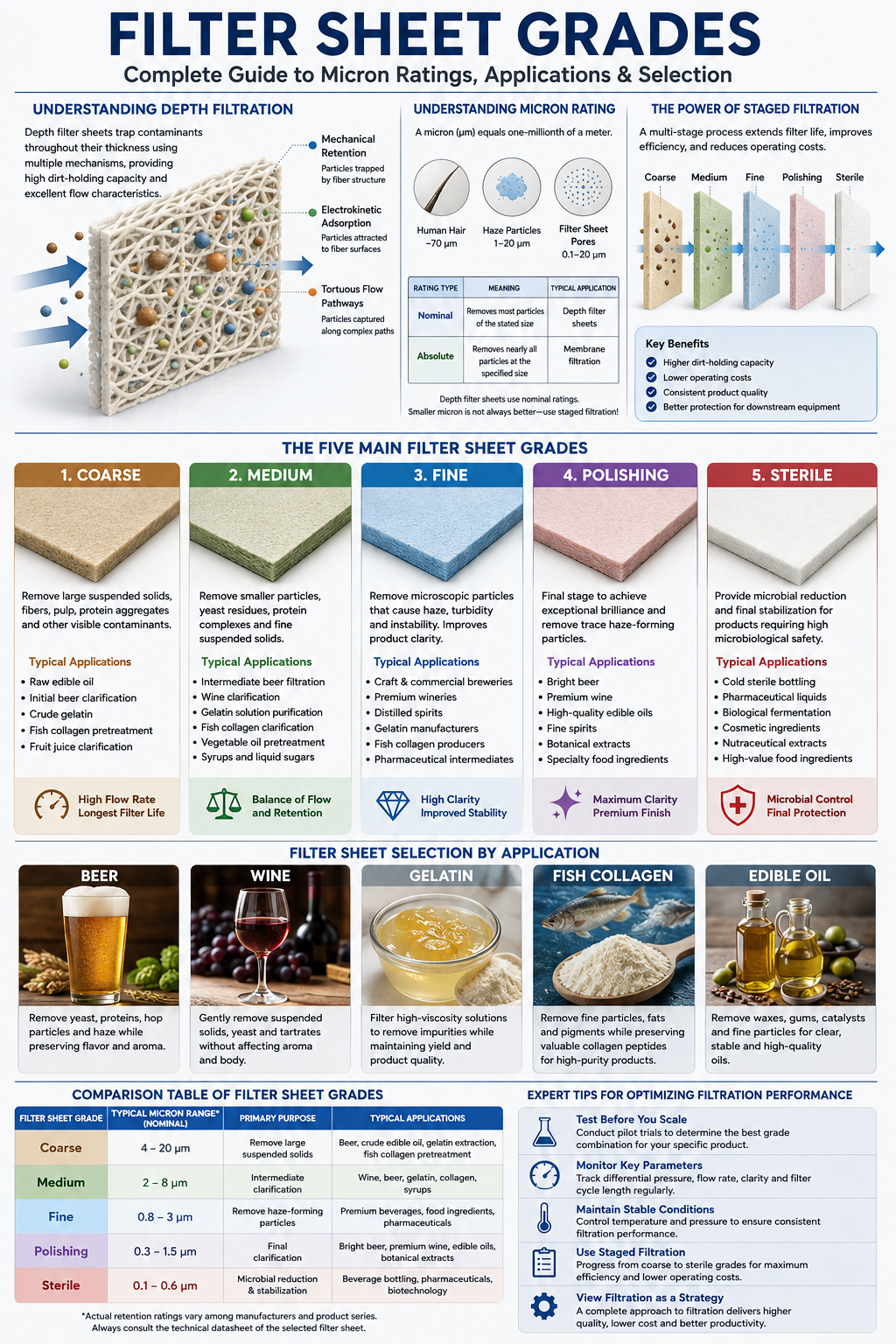
What Are Filter Sheet Grades?
Selecting the correct filter sheet grades is one of the most important decisions in any liquid filtration process. Whether you produce beer, wine, gelatin, fish collagen, or edible oil, the filtration media directly affects product clarity, production efficiency, operating cost, and final product quality. Many people believe filtration simply means trapping particles, but modern depth filtration is far more sophisticated than that. Today’s filter sheets combine mechanical retention, adsorption, and depth capture, allowing them to remove particles ranging from visible solids to microorganisms depending on the selected grade. Manufacturers including Pall, Eaton, and Parker now offer dozens of filtration grades covering nominal retention from approximately 4 μm down to 0.1 μm, making grade selection increasingly important for industrial processing.
Unlike surface filters that trap contaminants only on the outer layer, depth filter sheets consist of cellulose fibers, mineral filter aids, and carefully engineered pore structures. Particles become trapped throughout the thickness of the media, greatly increasing dirt-holding capacity and extending service life. This is why plate-and-frame filtration systems remain widely used across breweries, wineries, edible oil plants, gelatin manufacturers, and collagen processing facilities worldwide. Understanding how each filtration grade performs is the foundation of effective filter sheet selection, helping operators achieve the right balance between clarity, flow rate, product yield, and operating costs.
Understanding Depth Filtration
Depth filtration works much like walking through a dense forest. Imagine trying to throw a handful of leaves through thick trees. Some leaves hit the first trees, others travel deeper before getting trapped, while the smallest pieces may pass entirely through. Filter sheets behave in a similar way. Instead of relying on a single surface barrier, contaminants are captured throughout multiple layers of fibers and filter aids. This layered structure provides significantly higher contaminant loading than membrane filtration alone while maintaining excellent flow characteristics.
Modern depth filter sheets rely on three primary filtration mechanisms:
Mechanical particle retention
Electrokinetic adsorption
Tortuous flow pathways
Because several mechanisms work simultaneously, particles much smaller than the nominal micron rating may also be retained through adsorption rather than simple size exclusion. This explains why filter sheet performance cannot be judged solely by pore size.
Why Filter Sheet Grades Matter
Choosing an incorrect grade often creates more problems than it solves. Selecting a sheet that is too coarse may leave haze, sediment, yeast, or suspended solids in the finished product. Choosing an excessively fine sheet may dramatically reduce flow rate, increase pressure differential, shorten service life, and even remove desirable components.
Experienced filtration engineers usually recommend designing a staged filtration process rather than relying on a single filter sheet. Each stage removes progressively smaller contaminants, extending filter life while reducing operating costs. This principle is especially important in beer, wine, and fish collagen production where product quality depends on maintaining both clarity and flavor.
Understanding Micron Rating
One of the most misunderstood specifications during filter sheet selection is the micron rating. Many buyers assume a lower micron number automatically means better filtration. While finer retention often produces a brighter product, it also increases pressure drop, reduces throughput, and shortens filter life if upstream clarification is insufficient.
A micron (μm) equals one-millionth of a meter. Human hair measures approximately 70 microns in diameter, while many haze-forming particles found in beverages range between 1 and 20 microns. Industrial depth filter sheets commonly cover nominal retention ranges from approximately 4 μm down to 0.1 μm, depending on the manufacturer and filtration series.
Nominal vs. Absolute Micron Rating
Not all micron ratings describe the same performance. The two most common specifications are:
| Rating Type | Meaning | Typical Application |
| Nominal | Removes most particles of the stated size | Depth filter sheets |
| Absolute | Removes nearly all particles at the specified size | Membrane filtration |
Depth filter sheets are generally described using nominal retention, meaning they efficiently remove the majority of particles around their rated size while adsorption mechanisms capture even smaller contaminants. Membrane filters, on the other hand, use absolute ratings because they function primarily as surface barriers.
Why Smaller Isn’t Always Better
Many first-time users instinctively choose the finest available sheet. Unfortunately, this often leads to premature clogging and higher production costs. Imagine trying to strain muddy water directly through a coffee filter. It blocks almost immediately. The same principle applies to industrial filtration.
Instead, professional filtration systems normally progress through multiple stages:
Coarse
Medium
Fine
Polishing
Sterile
This cascading approach dramatically extends service life while producing superior filtration efficiency.
The Five Main Filter Sheet Grades
Coarse Filter Sheets
Coarse filter sheets represent the first stage of industrial clarification. Their primary objective is removing large suspended solids, fibers, pulp, protein aggregates, filter aids, and other visible contaminants before finer filtration begins. Because they possess relatively open pore structures, they offer the highest flow rates and longest operating life.
Typical applications include:
Raw edible oil
Initial beer clarification
Crude gelatin
Early fish collagen processing
Fruit juice clarification
These grades are especially valuable when liquids contain heavy contaminant loads. Rather than attempting complete clarification in one pass, coarse filtration protects downstream media and significantly lowers total filtration cost. Industrial manufacturers commonly recommend coarse sheets as prefilters whenever suspended solids are abundant.
The Five Main Filter Sheet Grades
Medium Filter Sheets
After the initial clarification stage, Medium filter sheet grades take over to remove smaller suspended particles that remain in the liquid. These sheets strike an excellent balance between dirt-holding capacity and particle retention, making them one of the most widely used grades across food, beverage, and biopharmaceutical industries. If Coarse sheets are comparable to a large fishing net, Medium sheets are like a finely woven basket—they still allow high flow rates while capturing much smaller impurities.
In many production facilities, medium-grade sheets serve as the workhorse of the filtration process. They remove fine proteins, yeast residues, colloidal particles, and residual solids that escaped the coarse filtration stage without significantly slowing production. Their relatively low pressure drop also helps reduce energy consumption and extends the service life of downstream Fine or Polishing filter sheets. This staged approach is especially beneficial for manufacturers processing variable raw materials, where contaminant loads may change from batch to batch.
Typical applications include:
Intermediate Beer filtration before polishing
Wine clarification after fermentation
Gelatin solution purification
Fish collagen intermediate clarification
Vegetable oil pretreatment
Syrups and liquid sugar processing
Because medium-grade sheets are extremely versatile, many facilities keep multiple medium retention levels in stock. Production managers can then adjust the filtration sequence according to seasonal raw material quality, desired throughput, and finished product specifications.
Fine Filter Sheets
Fine filter sheet grades are designed to remove microscopic particles responsible for haze, turbidity, and instability. At this stage, the liquid already contains relatively few suspended solids, allowing the tighter pore structure to operate efficiently without clogging prematurely. Fine filtration significantly improves product appearance while helping extend shelf life by reducing suspended contaminants that may later settle or react during storage.
Fine-grade sheets are particularly important in premium beverage production, where consumers expect brilliant clarity. Even tiny protein complexes, yeast fragments, or colloidal particles can scatter light and create visible haze. A properly selected fine filter sheet effectively removes these contaminants while maintaining flavor, aroma, and color. This balance is one reason why depth filtration remains popular despite advances in membrane technology—it offers excellent clarification with minimal impact on product characteristics.
Industries commonly using fine grades include:
Craft and commercial breweries
Premium wineries
Distilled spirits
Gelatin manufacturers
Fish collagen producers
Pharmaceutical intermediates
Although finer retention generally improves clarity, operators should avoid skipping upstream filtration stages. Feeding heavily contaminated liquid directly into fine sheets dramatically shortens filter life and increases operating costs. The most efficient systems always combine coarse, medium, and fine filtration to maximize productivity.
Polishing Filter Sheets
Once most suspended particles have been removed, Polishing filter sheets provide the finishing touch. Their purpose is not simply to make the liquid look clearer but to achieve exceptional visual brilliance while minimizing remaining microscopic contaminants. In many premium beverage applications, polishing filtration is the final step before bottling, where appearance directly influences customer perception and purchasing decisions.
Think of polishing filtration like detailing a luxury car after washing it. The vehicle is already clean, but polishing removes the tiny imperfections that separate an ordinary finish from a showroom-quality appearance. Similarly, polishing filter sheets eliminate trace haze-forming particles that may not be obvious immediately but could become visible during storage or temperature fluctuations.
Common polishing applications include:
Bright Beer
Premium Wine
High-quality edible oils
Fine spirits
Botanical extracts
Specialty food ingredients
Besides improving clarity, polishing filtration also reduces microbial load and prepares products for final stabilization. Many beverage producers pair polishing sheets with membrane filters to maximize microbial protection while maintaining excellent flow characteristics.
Sterile Filter Sheets
Sterile filter sheet grades represent the highest level of depth filtration. These specialized sheets are engineered to achieve substantial microbial reduction while maintaining the high contaminant-holding capacity associated with depth filtration technology. Although they are not always a replacement for sterilizing membrane filters, sterile-grade sheets provide an effective barrier against yeast, mold, and many bacteria, making them valuable in applications requiring enhanced microbiological safety.
One significant advantage of sterile filter sheets is their ability to handle liquids with relatively low levels of suspended solids while simultaneously improving microbiological quality. This dual function reduces the burden placed on downstream membrane filters and often increases overall process efficiency. For many beverage and pharmaceutical manufacturers, sterile filtration forms part of a comprehensive microbial control strategy rather than acting as the sole sterilization method.
Typical applications include:
Cold sterile bottling
Pharmaceutical process liquids
Biological fermentation products
Cosmetic ingredients
Nutraceutical extracts
High-value food ingredients
Selecting sterile-grade filter sheets requires careful consideration of regulatory requirements, microbial targets, and validation procedures. Manufacturers should always verify compatibility with their specific process conditions and quality standards.
Filter Sheet Selection by Application
Different industries require different filtration strategies. Even products that appear similar may have completely different contaminant profiles, viscosities, and quality requirements. Successful filter sheet selection depends on understanding both the product and the filtration objective rather than focusing solely on micron rating.
Beer Filtration
Beer presents one of the most demanding filtration challenges because it contains yeast, proteins, polyphenols, hop particles, and various colloidal materials that can create haze or sediment. Brewers must remove these contaminants while preserving flavor, aroma, carbonation, and mouthfeel. Over-filtration may produce crystal-clear beer but can also strip desirable flavor compounds, especially in craft styles where haze may actually be part of the product identity.
A typical beer filtration process follows multiple stages. Coarse sheets remove spent yeast and large particles after fermentation. Medium grades reduce protein complexes and remaining suspended solids. Fine sheets improve brilliance before packaging, while polishing or sterile grades may be used depending on the desired shelf life and microbial stability. Many breweries carefully monitor differential pressure during filtration because rising pressure indicates that the sheets are approaching their contaminant-holding capacity.
For modern breweries, filtration is no longer simply about achieving clarity—it is about balancing visual appeal, flavor retention, production efficiency, and product stability. Selecting the appropriate grade at each stage ensures consistent quality while minimizing filtration costs and product losses.
Wine Filtration
Wine filtration requires a delicate approach because excessive filtration can influence aroma, body, and aging potential. Winemakers seek to remove suspended solids, yeast cells, tartrate crystals, and microorganisms without altering the wine’s unique sensory profile. The correct filter sheet grades help achieve this balance by gradually reducing contaminants through staged clarification rather than relying on aggressive single-pass filtration.
Young wines often begin with coarse or medium filtration to remove fermentation residues before progressing to fine or polishing grades. Premium wines intended for long-term aging may receive gentler filtration to preserve structure, whereas wines destined for immediate consumption often undergo tighter polishing or sterile filtration to maximize shelf stability. Sweet wines generally require greater microbial control because residual sugars provide nutrients for spoilage organisms.
Professional wineries frequently perform filtration trials before large production runs. Testing different sheet grades helps determine the optimal combination of clarity, flow rate, and sensory preservation, ensuring that filtration enhances rather than diminishes wine quality.
Gelatin Filtration
Gelatin production presents unique filtration challenges because the process involves highly viscous solutions containing proteins, fats, insoluble particles, minerals, and residual raw material impurities. Unlike beverages, where visual clarity is often the primary objective, gelatin filtration must achieve both high purity and excellent process efficiency without reducing product yield. Selecting the appropriate filter sheet grades is therefore essential for maintaining consistent quality while preventing excessive pressure buildup during production.
Most gelatin manufacturers employ a multi-stage filtration process. Coarse filter sheets first remove large insoluble particles and processing residues generated during extraction. Once the bulk solids have been eliminated, Medium grades capture finer suspended materials and protein aggregates that could otherwise foul downstream equipment. Depending on the final application—whether pharmaceutical capsules, confectionery, dairy ingredients, or photographic gelatin—Fine or Polishing sheets are then used to achieve the required clarity and purity.
Temperature also plays a major role in gelatin filtration. Because viscosity increases rapidly as gelatin cools, filtration is usually performed under carefully controlled thermal conditions to maintain stable flow rates. Even the best filter sheet cannot compensate for poor process control if the solution begins to gel inside the filtration system. For this reason, experienced manufacturers consider temperature management, differential pressure, and filtration grade selection as equally important variables in achieving high production efficiency.
Fish Collagen Filtration
The global demand for Fish Collagen has expanded rapidly in recent years, driven by growth in nutraceuticals, cosmetics, functional beverages, and medical applications. Producing high-quality collagen requires removing suspended proteins, fats, pigments, minerals, and fine insoluble particles while preserving the collagen peptides responsible for the product’s functionality. Because collagen solutions are highly valuable, maximizing yield while minimizing filtration losses is a top priority.
A typical fish collagen production line begins with Coarse filtration to remove larger tissue fragments and extraction residues. Medium filter sheet grades then reduce fine suspended solids before Fine filtration improves appearance and overall purity. In premium collagen production, Polishing or Sterile filter sheets may be incorporated before concentration or spray drying to reduce microbial contamination and produce an exceptionally clean final ingredient.
One common misconception is that selecting the smallest available micron rating automatically produces the highest-quality collagen. In reality, filtration that is too aggressive may slow production dramatically and increase product retention inside the filter media, reducing overall yield. Manufacturers instead optimize their filter sheet selection through pilot-scale testing, evaluating not only clarity but also protein recovery, filtration cycle length, and production cost. This balanced approach helps ensure that the finished collagen meets demanding quality standards while maintaining commercial efficiency.
Edible Oil Filtration
Filtration plays a crucial role throughout the production of Edible Oil, from crude vegetable oils to refined cooking oils intended for consumer markets. During extraction and refining, oils contain waxes, gums, catalyst residues, carbon fines, bleaching earth particles, and other contaminants that must be removed without affecting the oil’s desirable characteristics. Selecting the correct filter sheet grades ensures efficient contaminant removal while maintaining high throughput and minimizing oil losses.
In many edible oil plants, Coarse sheets remove larger particles generated during pressing or bleaching. Medium grades capture smaller suspended solids before Fine or Polishing sheets improve the finished oil’s appearance by eliminating residual haze-forming particles. Premium oils, including olive oil and specialty seed oils, often require carefully optimized filtration because excessive clarification may remove naturally occurring compounds that contribute to flavor or nutritional value.
Another important consideration is operating cost. Since edible oil production typically involves high processing volumes, even small improvements in filter life can significantly reduce annual filtration expenses. By implementing staged filtration and selecting grades appropriate for each processing step, manufacturers can increase production efficiency while reducing filter consumption and product loss. The result is a cleaner oil, longer equipment life, and lower overall manufacturing costs.
Common Mistakes When Selecting Filter Sheet Grades
Even experienced operators occasionally make filtration decisions based on assumptions rather than process data. One of the most common mistakes is selecting the finest available micron rating under the belief that tighter filtration always produces a better product. While finer sheets certainly remove smaller particles, they also generate higher differential pressure, shorter service life, and reduced flow rates if upstream clarification is inadequate. The result is often higher operating costs without meaningful improvements in product quality.
Another frequent error is overlooking the characteristics of the liquid itself. Two products with similar appearances may behave completely differently during filtration due to differences in viscosity, protein content, particle size distribution, or temperature. For example, Beer, Wine, Gelatin, Fish Collagen, and Edible Oil each require distinct filtration strategies because the contaminants they contain differ substantially. Using identical filter sheet grades across these applications rarely produces optimal results.
Ignoring process monitoring is another costly mistake. Operators should routinely track differential pressure, flow rate, filtrate clarity, and filter cycle length. These measurements provide valuable insight into whether the selected grade is performing efficiently or whether adjustments are necessary. Rather than relying solely on visual inspection, data-driven filtration management allows manufacturers to improve consistency, reduce downtime, and extend filter life.
Expert Tips for Optimizing Filtration Performance
Successful filtration is about much more than choosing the correct filter sheet. The entire filtration system—including pumps, plate-and-frame equipment, operating pressure, temperature, and cleaning procedures—must work together as an integrated process. Experienced filtration engineers typically recommend conducting small-scale filtration trials before implementing a new production process. Pilot testing helps identify the optimal sequence of Coarse, Medium, Fine, Polishing, and Sterile grades while minimizing expensive trial-and-error during full-scale production.
Maintaining stable operating conditions also has a significant impact on filtration efficiency. Sudden pressure spikes can compress filter media and reduce flow, while excessive temperature variation may alter product viscosity, especially in gelatin and collagen processing. Monitoring differential pressure throughout the filtration cycle allows operators to replace sheets before severe clogging occurs, preventing unnecessary production interruptions and protecting downstream equipment.
Perhaps the most valuable advice is to view filter sheet selection as a complete filtration strategy rather than a single purchasing decision. Manufacturers who invest time in understanding contaminant characteristics, product requirements, and filtration objectives consistently achieve higher productivity, longer filter life, and better product quality. Over time, these incremental improvements translate into lower operating costs and more consistent production performance.
Comparison Table of Filter Sheet Grades
| Filter Sheet Grade | Typical Micron Range* | Primary Purpose | Typical Applications |
| Coarse | 4–20 μm | Remove large suspended solids | Beer, crude edible oil, gelatin extraction, fish collagen pretreatment |
| Medium | 2–8 μm | Intermediate clarification | Wine, beer, gelatin, collagen, syrups |
| Fine | 0.8–3 μm | Remove haze-forming particles | Premium beverages, food ingredients, pharmaceuticals |
| Polishing | 0.3–1.5 μm | Final clarification | Bright beer, premium wine, edible oils, botanical extracts |
| Sterile | 0.1–0.6 μm (nominal equivalent performance varies by manufacturer) | Microbial reduction and final stabilization | Beverage bottling, pharmaceuticals, biotechnology |
Conclusion
Selecting the appropriate filter sheet grades is one of the most important factors influencing filtration efficiency, product quality, and manufacturing cost. Rather than focusing exclusively on micron rating, successful filtration requires understanding the characteristics of the liquid, the nature of the contaminants, and the objective of each filtration stage. A well-designed sequence that progresses from Coarse to Medium, Fine, Polishing, and, when necessary, Sterile filtration delivers superior performance compared with relying on a single filtration grade.
Whether processing Beer, Wine, Gelatin, Fish Collagen, or Edible Oil, every application benefits from a filtration strategy tailored to its specific requirements. Manufacturers who combine proper filter sheet selection with pilot testing, process monitoring, and routine equipment maintenance consistently achieve higher product quality, longer filter life, improved production efficiency, and lower operating costs. In today’s competitive processing industries, understanding filter sheet grades is no longer just technical knowledge—it is a valuable advantage that directly contributes to operational success.
Frequently Asked Questions
- What are filter sheet grades?
Filter sheet grades classify depth filter sheets according to their particle retention capability, flow characteristics, and intended applications. Common categories include Coarse, Medium, Fine, Polishing, and Sterile grades.
- How do I choose the correct filter sheet grade?
Choose the grade based on your product, contaminant load, desired clarity, production capacity, and filtration objective. Pilot filtration testing is the most reliable way to determine the optimal filtration sequence.
- Does a smaller micron rating always provide better filtration?
No. Smaller micron ratings remove finer particles but also reduce flow rate and may clog faster. The most effective filtration systems typically use multiple grades in sequence rather than a single ultra-fine sheet.
- Which industries commonly use filter sheet filtration?
Depth filter sheets are widely used in Beer, Wine, Gelatin, Fish Collagen, Edible Oil, pharmaceuticals, cosmetics, biotechnology, food ingredients, and specialty chemical manufacturing.
- Why is staged filtration recommended?
Staged filtration extends filter life, improves contaminant removal efficiency, reduces operating costs, protects downstream equipment, and delivers more consistent product quality compared with single-stage filtration.
Post time: Jul-09-2026