Introduction
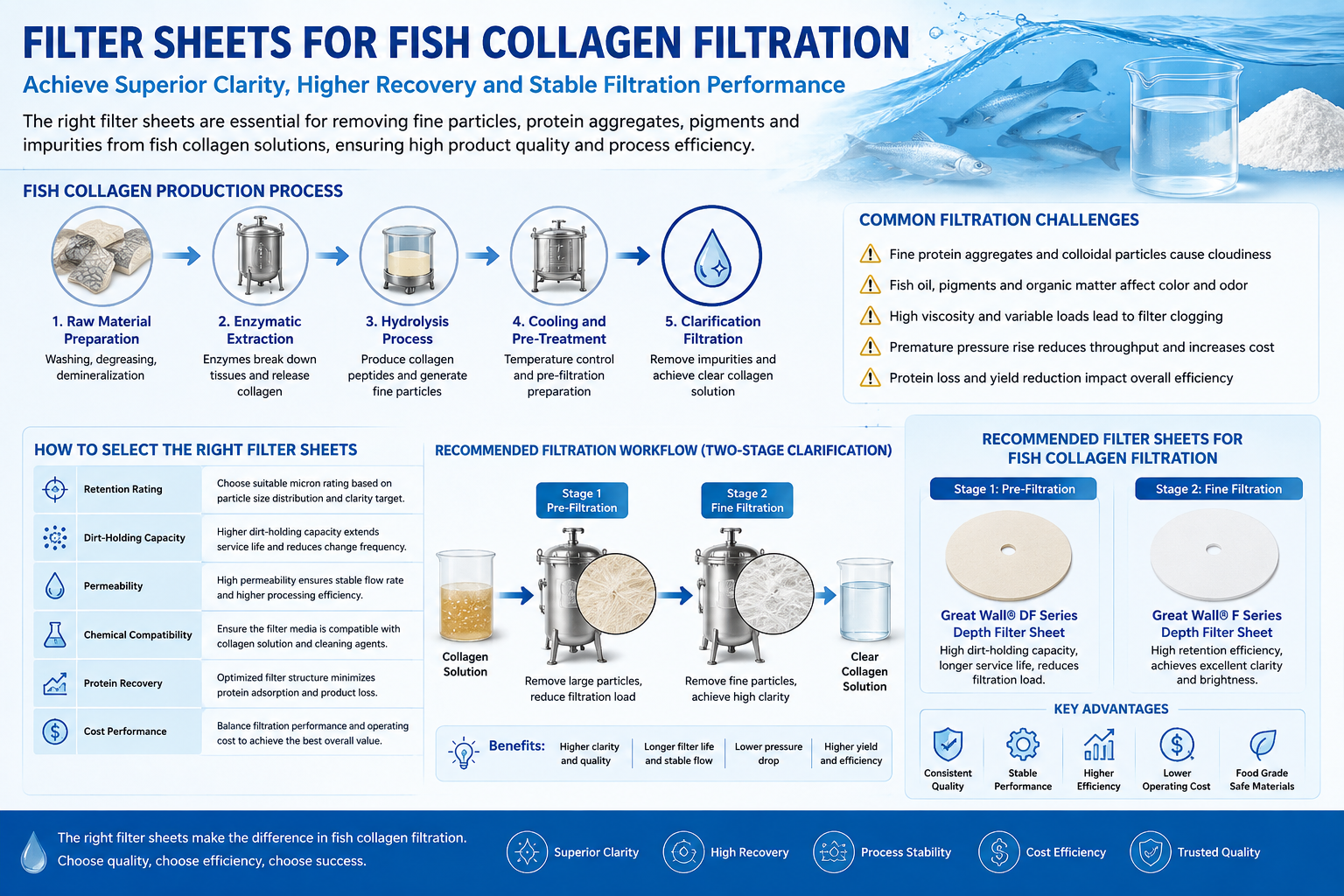
The global demand for fish collagen filtration solutions has increased rapidly as manufacturers expand production of marine collagen peptides, collagen beverages, nutritional supplements, cosmetics, and functional foods. Consumers now expect collagen products to deliver not only nutritional benefits but also exceptional clarity, attractive appearance, and consistent quality. Even when collagen extraction and enzymatic hydrolysis are carefully controlled, suspended solids, insoluble protein fragments, fish oil residues, pigments, and other microscopic impurities often remain in the solution. Without an effective collagen clarification process, these contaminants can reduce product transparency, shorten shelf life, interfere with downstream membrane filtration, and negatively impact customer perception.
Selecting the right filter sheets for fish collagen is therefore much more than choosing a filtration media with a particular retention rating. Manufacturers must balance filtration efficiency, throughput, protein recovery, operating costs, pressure drop, and filter service life. A filter sheet that is too coarse may fail to remove fine particles, while one that is too fine may clog prematurely and slow production. Depth filtration has become one of the preferred technologies because it captures particles throughout the thickness of the media rather than only on the surface, providing higher dirt-holding capacity and more stable performance during continuous processing. Industry case studies have shown that a properly designed two-stage clarification process can significantly improve solution transparency while maintaining stable filtration performance and production efficiency.
This guide explains every major aspect of selecting filter sheets for fish collagen filtration, from understanding the production process and identifying common filtration challenges to choosing suitable filter grades and designing an optimized clarification workflow.
Understanding Fish Collagen Production
Raw Material Preparation
Fish collagen production begins with carefully selected marine raw materials such as fish skin, scales, or bones. These by-products are rich in collagen but also contain fats, pigments, minerals, connective tissue, and other impurities that must be removed before extraction. Proper washing, trimming, and pretreatment directly influence the filtration load later in the process. If excessive oil or insoluble matter remains, filter sheets may blind quickly, reducing throughput and increasing operating costs.
Manufacturers typically perform degreasing and demineralization before collagen extraction. These pretreatment steps not only improve collagen purity but also reduce the concentration of suspended particles entering the clarification stage. Even with efficient preparation, microscopic particles remain dispersed throughout the liquid, making mechanical clarification an essential downstream operation. The better the upstream preparation, the longer the service life of the filter sheets and the lower the overall filtration cost.
Enzymatic Extraction
Modern fish collagen production relies heavily on enzymatic extraction because it operates under relatively mild conditions, preserving the biological activity of collagen while achieving high extraction efficiency. Proteolytic enzymes gradually break down connective tissues, releasing collagen molecules into solution. During this stage, numerous insoluble fragments, residual proteins, and cellular debris are generated.
These contaminants vary greatly in particle size, creating one of the biggest challenges for filtration. Large particles may be removed easily, but smaller protein aggregates often remain suspended for extended periods. If they are not removed effectively, they can interfere with concentration, membrane filtration, sterilization, or spray drying later in the manufacturing process. The extraction stage therefore determines both the complexity of clarification and the required retention characteristics of the filter media.
Hydrolysis Process
Many commercial products undergo controlled hydrolysis to produce fish collagen peptides with lower molecular weights and improved bioavailability. Hydrolysis creates additional fine particles and colloidal materials that are difficult to separate using ordinary surface filters. The resulting solution often appears cloudy despite containing valuable collagen peptides.
This is precisely where depth filter sheets demonstrate their advantage. Rather than capturing contaminants only on the surface, depth media retain particles throughout multiple layers of cellulose fibers and mineral components. This three-dimensional structure allows high dirt-holding capacity while maintaining relatively stable flow rates throughout filtration. Research and industrial application consistently show that staged clarification provides better process stability than relying on a single high-retention filter.
Cooling and Pre-Treatment
Before clarification, collagen solutions are commonly cooled or held within a controlled temperature range suitable for filtration. Proper temperature management reduces viscosity fluctuations and improves process consistency. Excessively low temperatures may increase viscosity and reduce flow, while temperatures that are too high may negatively affect filter performance or product stability.
Many manufacturers also perform preliminary screening or settling before depth filtration to remove larger suspended solids. Although this step cannot replace clarification-grade filter sheets, it significantly reduces the contaminant load entering the primary filtration stage. This approach extends filter life, reduces differential pressure, and improves overall production efficiency.
Why Filtration Matters in Fish Collagen Manufacturing
Product Appearance
For premium collagen products, appearance is almost as important as nutritional value. Consumers naturally associate crystal-clear liquids with higher quality and better manufacturing standards. Even when turbidity has no effect on nutritional content, visible particles or haze can reduce consumer confidence and damage brand reputation.
Depth filtration removes suspended solids responsible for cloudiness while preserving valuable collagen components. Recent industrial filtration trials demonstrated that optimized clarification significantly reduced turbidity and produced a transparent, visually appealing collagen solution suitable for downstream processing.
Process Efficiency
Clarification protects downstream membrane filters, sterilizing filters, evaporators, and filling equipment. Removing particles early reduces fouling, minimizes maintenance, and extends the service life of expensive downstream filtration systems. Plants that skip proper clarification often experience more frequent membrane replacement, increased production interruptions, and higher operating costs.
Shelf Life
Particles remaining in collagen solutions may promote instability during storage. Insoluble materials can settle over time, causing sedimentation that negatively affects product appearance and consistency. Effective clarification contributes to better storage stability while improving overall product quality, making it an essential step rather than an optional finishing process.
Common Filtration Challenges
High Suspended Solids
Fish collagen solutions often contain a broad distribution of suspended particles originating from raw materials and extraction processes. Large contaminants are relatively easy to remove, but medium-sized particles can quickly accumulate on the filter surface if inappropriate media are selected. This leads to rapid pressure increases and shortened filter life.
Depth filter sheets alleviate this issue by trapping particles throughout the thickness of the media rather than only on the surface. Their high contaminant-holding capacity enables longer production cycles and more stable filtration performance.
Fine Protein Particles
Some protein aggregates measure only a few micrometers in diameter yet remain responsible for significant turbidity. These particles frequently bypass coarse filtration while contributing heavily to cloudiness. Selecting clarification-grade depth media with suitable retention characteristics is therefore critical for achieving high product transparency.
High Viscosity
Fish collagen solutions can exhibit relatively high viscosity, especially at elevated collagen concentrations. High viscosity naturally reduces filtration flux and increases pressure requirements. Maintaining appropriate operating temperatures and selecting filter sheets with balanced permeability helps sustain productivity while avoiding excessive pressure buildup.
Filter Blocking
Premature clogging is one of the most common reasons for reduced production efficiency. Using a filter grade that is finer than necessary often decreases throughput dramatically without providing proportional improvements in clarity. Industrial practice increasingly favors staged filtration, beginning with coarse clarification followed by fine clarification and, when necessary, activated carbon treatment for odor and color improvement. Recent production trials confirmed that this multi-stage approach provides excellent impurity removal while maintaining stable filtration efficiency throughout continuous operation.
Recommended Filter Sheet Grades
Choosing the appropriate filter sheets for fish collagen is one of the most critical decisions in the entire fish collagen filtration process. Every production line has unique characteristics depending on raw material quality, enzymatic treatment, collagen concentration, production capacity, and desired product clarity. There is no universal filter grade that works perfectly for every application. Instead, manufacturers generally achieve the best results by designing a multi-stage clarification process in which each filter sheet performs a specific function.
Depth filter sheets are particularly suitable because they combine mechanical retention, adsorption, and depth entrapment within a thick porous structure. Unlike membrane filters that mainly capture particles on their surface, depth media retain contaminants throughout multiple layers of cellulose fibers and mineral filter aids. This significantly increases dirt-holding capacity, extends service life, and reduces pressure buildup during production.
A properly selected filtration sequence typically improves:
Collagen clarification
Product transparency
Production efficiency
Filter lifetime
Downstream membrane protection
Overall manufacturing cost
The following recommendations represent common industrial practice.
Coarse Clarification
The first filtration stage focuses on removing large suspended solids generated during extraction and hydrolysis. These include tissue fragments, undissolved proteins, connective fibers, residual fish scales, and other relatively large contaminants.
Using an excessively fine filter at this stage is rarely economical because large particles rapidly blind the media. Instead, a coarse clarification sheet with high dirt-holding capacity captures the majority of solids while maintaining high flow rates.
Typical removal targets include:
| Filtration Objective | Typical Particle Size |
| Large suspended solids | 20–100 μm |
| Tissue fragments | >30 μm |
| Fat agglomerates | Variable |
| Insoluble collagen residues | 10–50 μm |
Because depth filter sheets store contaminants throughout the media thickness, they continue operating efficiently long after ordinary surface filters begin clogging. This significantly lowers replacement frequency during continuous production.
Many manufacturers install pressure gauges before and after the filter press. Monitoring differential pressure allows operators to determine the optimal replacement point rather than changing filter sheets based solely on operating time.
Fine Clarification
After coarse clarification, the collagen solution generally appears much cleaner but still contains microscopic particles responsible for haze.
Fine clarification removes:
Protein aggregates
Colloidal particles
Fine suspended solids
Residual pigments
Small insoluble materials
This stage has the greatest influence on the visual appearance of the finished collagen solution.
A common mistake is selecting the tightest available filter media in pursuit of maximum clarity. While this may improve turbidity slightly, it often reduces production efficiency because extremely fine media clog much faster.
Instead, manufacturers should balance:
- Required clarity
- Production capacity
- Pressure increase
- Filter lifetime
- Product recovery
Many successful production lines achieve excellent transparency using medium-to-fine depth filter sheets before any membrane filtration is introduced.
Activated Carbon Filter Sheets
Some fish collagen products exhibit slight marine odors or light coloration depending on the raw materials and extraction process.
Activated carbon depth filter sheets provide two simultaneous functions:
- Mechanical clarification
- Adsorption of color and odor compounds
Unlike loose activated carbon powder, carbon filter sheets eliminate the need for additional dosing and subsequent carbon removal. The activated carbon remains embedded within the cellulose matrix, making operation cleaner and easier.
Applications include:
- Premium collagen beverages
- Functional food ingredients
- Cosmetic collagen solutions
- Pharmaceutical intermediates
Because activated carbon may adsorb certain desirable compounds if overused, manufacturers should evaluate dosage and contact time through pilot testing before full-scale production.
Selecting Filter Grades Based on Process Goals
The optimal filter grade depends more on production objectives than on a single micron rating.
| Production Goal | Recommended Filtration Strategy |
| Remove coarse solids | High-capacity coarse depth sheet |
| Improve clarity | Medium-to-fine depth sheet |
| Remove haze | Fine clarification sheet |
| Improve color | Activated carbon sheet |
| Reduce odor | Activated carbon sheet |
| Protect membrane filters | Multi-stage clarification |
Rather than relying on one filter sheet to accomplish every task, staged filtration distributes the contaminant load across several media. This approach extends filter life, reduces operating costs, and provides more consistent product quality.
Typical Fish Collagen Filtration Process
Although production lines vary among manufacturers, most successful fish collagen filtration systems follow a similar workflow designed to gradually remove contaminants while protecting downstream equipment.

This staged design minimizes pressure spikes and maximizes filter utilization.
Step 1 – Pretreatment
Pretreatment removes:
- Fish scales
- Bones
- Large tissue fragments
- Oils
- Minerals
Better pretreatment directly reduces filtration costs later.
Step 2 – Coarse Depth Filtration
This stage captures most suspended solids before they reach finer filters.
Benefits include:
- Lower downstream fouling
- Longer filter life
- Higher production throughput
- Stable pressure
Many manufacturers report that this stage removes the majority of visible impurities.
Step 3 – Fine Clarification
Fine depth filtration significantly reduces turbidity.
At this point the collagen solution becomes:
- Visually transparent
- More stable
- Easier to sterilize
- Better suited for concentration
Fine clarification also protects expensive membrane cartridges from premature fouling.
Step 4 – Optional Activated Carbon Treatment
Activated carbon filtration is selected when manufacturers need additional improvement in:
- Odor
- Color
- Taste
This step is especially common for collagen beverages intended for direct human consumption.
Step 5 – Membrane Filtration
After depth filtration has removed most suspended particles, membrane filters operate under much lighter loading conditions.
Benefits include:
- Longer membrane life
- Lower cleaning frequency
- Higher productivity
- Reduced operating costs
Without effective clarification, membrane fouling becomes one of the largest production expenses.
Step 6 – Final Processing
After clarification, the collagen solution proceeds to:
- Vacuum concentration
- Sterile filtration
- Spray drying
- Liquid packaging
Because impurities have already been removed, downstream equipment operates more consistently, resulting in higher product quality and reduced maintenance.
One of the biggest advantages of staged collagen clarification is process stability. Rather than forcing a single filter sheet to remove every contaminant, each stage handles a specific particle size range. This balanced approach not only improves clarity but also increases throughput, reduces downtime, and lowers the overall cost of production.
Case Study: Improving Fish Collagen Clarification with Multi-Stage Depth Filtration
Every fish collagen production line has its own characteristics, but the following example reflects a typical industrial application based on common depth filtration practices. Customer names and proprietary production details have been omitted.
Background
A marine collagen manufacturer producing collagen peptides from fish skin experienced several recurring issues during production:
- The collagen solution remained visibly hazy after enzymatic hydrolysis.
- Downstream membrane filters fouled quickly, requiring frequent cleaning and replacement.
- Product appearance varied from batch to batch, making quality control more difficult.
- Filtration throughput decreased rapidly because filters clogged before the planned production cycle ended.
The company wanted to improve fish collagen filtration without reducing collagen recovery or significantly increasing production costs.
Existing Process
The original production process was:
Raw Material → Enzymatic Extraction → Hydrolysis → Single Fine Filtration → Membrane Filtration → Concentration
Using only one fine filter sheet meant that both large and small particles accumulated on the same media. As production continued, differential pressure increased rapidly, reducing flow rate and shortening filter life.
Optimized Filtration Process
After evaluating the process, the filtration sequence was redesigned as follows:

Instead of relying on one filtration step, the contaminant load was distributed across multiple stages. Large suspended solids were removed first, allowing the fine clarification sheet to focus on smaller particles responsible for turbidity.
Results
After implementing the staged clarification process, the manufacturer observed several improvements:
| Performance Indicator | Before Optimization | After Optimization |
| Solution appearance | Slightly cloudy | Clear and bright |
| Filter service life | Short | Significantly extended |
| Differential pressure increase | Rapid | Stable |
| Membrane fouling | Frequent | Reduced |
| Production efficiency | Moderate | Improved |
| Batch consistency | Variable | More consistent |
Although the exact results varied depending on raw material quality and production conditions, the overall trend was clear: staged depth filtration reduced the contaminant load before membrane filtration, resulting in a more stable and efficient production process.
Why the Process Worked
The success of the optimized system came from matching each filtration stage to a specific task.
The coarse depth filter sheet removed larger suspended solids before they could overload the finer media. The fine clarification sheet then efficiently captured smaller protein aggregates and colloidal particles that caused haze. When necessary, an activated carbon filter sheet further improved color and reduced residual marine odor without introducing loose carbon powder into the process.
Because contaminants were removed progressively, pressure increased more slowly across each filtration stage. Operators were able to complete longer production runs with fewer filter changes, reducing downtime and lowering overall operating costs.
Best Practices for Choosing Filter Sheets for Fish Collagen
Selecting the right filter sheets for fish collagen involves more than choosing a nominal retention rating. Manufacturers should evaluate the entire production process and consider how each filtration stage contributes to product quality and process efficiency.
Some practical recommendations include:
- Characterize your feed solution. Measure turbidity, suspended solids, viscosity, and temperature before selecting filter media.
- Use staged filtration. Combining coarse and fine clarification generally provides better performance than using a single tight filter sheet.
- Avoid over-filtration. Selecting media that are finer than necessary can reduce flow rate, increase pressure, and shorten filter life without delivering meaningful improvements in clarity.
- Monitor differential pressure. Replace filter sheets based on pressure rise rather than fixed operating time whenever possible.
- Conduct pilot trials. Small-scale filtration tests help determine the most suitable filter grades before full-scale implementation.
- Protect downstream equipment. Effective clarification significantly reduces fouling of membrane filters, evaporators, and sterilizing filters, lowering maintenance costs over time.
By taking a systematic approach to filter selection, manufacturers can achieve a balance between product clarity, throughput, and operating cost.
Conclusion
Producing high-quality marine collagen requires more than efficient extraction and hydrolysis. The clarification stage plays a decisive role in determining the appearance, consistency, and overall quality of the finished product. An effective fish collagen filtration process removes suspended solids, protein aggregates, pigments, and other impurities while protecting downstream equipment and maintaining high production efficiency.
Depth filter sheets have become a preferred solution because of their high dirt-holding capacity, excellent particle retention, and ability to capture contaminants throughout the filter media rather than only on the surface. When combined in a staged filtration process—including coarse clarification, fine clarification, and optional activated carbon treatment—they provide a practical and cost-effective approach for achieving superior collagen clarification.
Ultimately, the best filter sheets for fish collagen are those selected according to the characteristics of the feed solution, the desired product quality, and the requirements of the overall manufacturing process. Pilot testing, process monitoring, and regular performance evaluation remain essential for optimizing filtration efficiency and ensuring consistent production of high-quality fish collagen products.
Frequently Asked Questions
- Why is fish collagen filtration necessary?
Fish collagen filtration removes suspended solids, protein aggregates, fats, pigments, and other impurities that can affect product clarity, stability, and downstream processing. Proper clarification also protects membrane filters and improves production efficiency.
- What are depth filter sheets?
Depth filter sheets are porous filtration media made from cellulose fibers and filter aids. Unlike surface filters, they retain particles throughout the thickness of the media, providing higher contaminant-holding capacity and longer service life.
- Should fish collagen be filtered in multiple stages?
Yes. A multi-stage process—typically consisting of coarse clarification followed by fine clarification—generally offers better filtration efficiency, longer filter life, and improved product consistency than a single filtration stage.
- Can activated carbon filter sheets improve collagen quality?
Activated carbon filter sheets can help reduce unwanted color, odor, and trace organic impurities while simultaneously providing mechanical filtration. They are commonly used when producing premium collagen beverages and cosmetic-grade collagen solutions.
- How do I choose the best filter sheets for fish collagen?
The best choice depends on factors such as raw material quality, turbidity, viscosity, production capacity, and the desired level of collagen clarification. Pilot testing different filter grades under actual production conditions is the most reliable way to determine the optimal filtration sequence.
Post time: Jul-07-2026