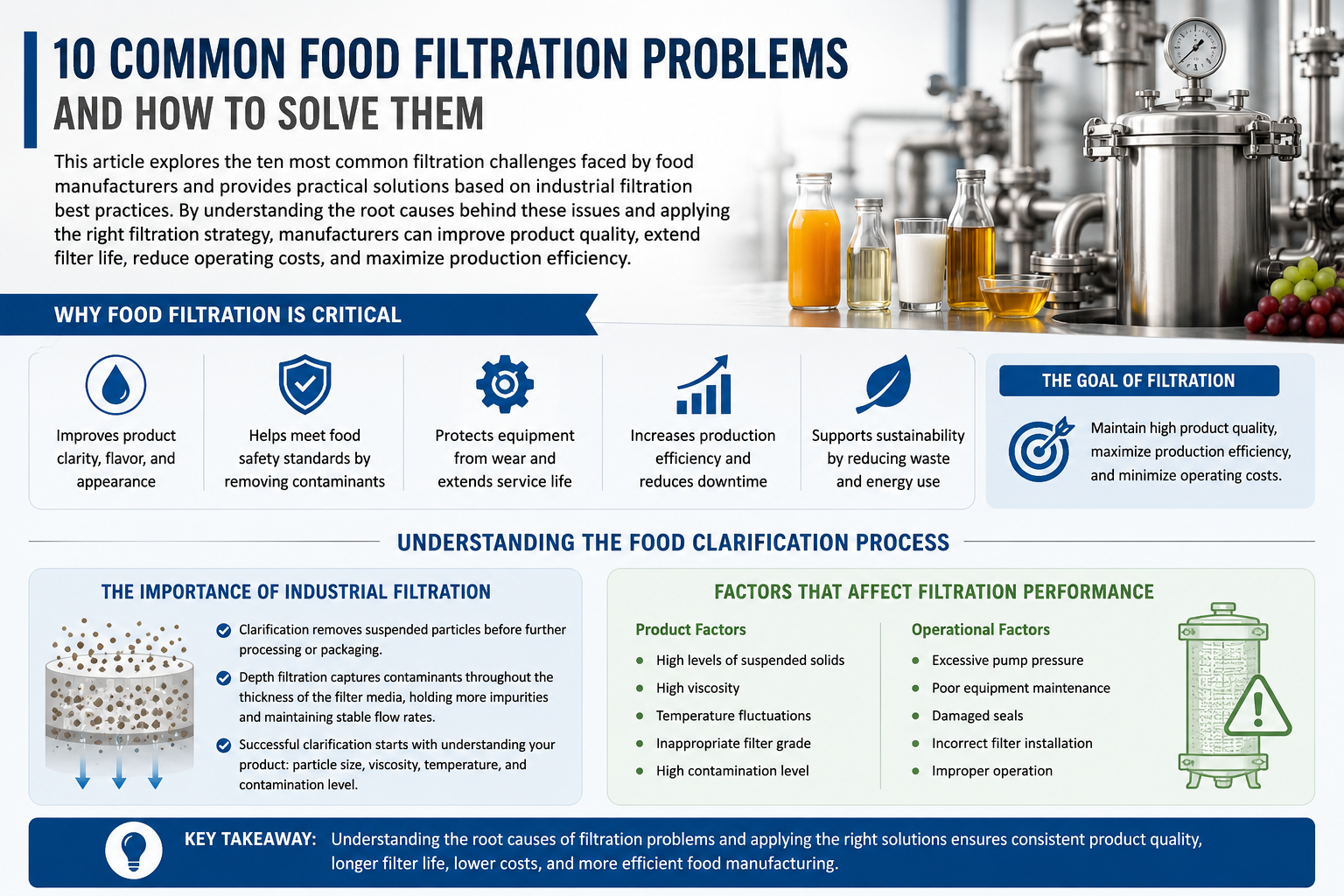
Food manufacturers today operate in an increasingly competitive market where product quality, production efficiency, and food safety standards are higher than ever before. Whether producing beverages, edible oils, gelatin, syrups, dairy ingredients, sweeteners, wine, beer, or food additives, manufacturers depend on reliable food filtration systems to remove suspended solids, improve product clarity, and maintain consistent quality from batch to batch. Even a small filtration issue can lead to increased production costs, excessive downtime, customer complaints, or even rejected products.
The clarification process is one of the most important stages in liquid food processing. Its purpose is not only to produce a visually clear product but also to protect downstream equipment, improve shelf life, and reduce microbial contamination before final packaging. However, achieving stable filtration performance is often more challenging than expected. Variations in raw materials, changes in product viscosity, incorrect filter media, and equipment wear can all contribute to common filtration problems that reduce efficiency and increase operating expenses.
This article explores the ten most common filtration challenges faced by food manufacturers and provides practical solutions based on industrial filtration best practices. By understanding the root causes behind these issues and applying the right filtration strategy, manufacturers can improve product quality, extend filter life, reduce operating costs, and maximize production efficiency.
Why Food Filtration Is Critical in Modern Food Manufacturing
Food filtration is far more than a simple polishing step before packaging. It is a critical process that directly influences product appearance, flavor, stability, and shelf life. Consumers naturally associate a clear beverage, refined edible oil, or transparent syrup with higher quality. Even when a product is perfectly safe to consume, visible haze or suspended particles can negatively affect purchasing decisions.
Beyond aesthetics, industrial filtration helps manufacturers comply with food safety regulations by removing unwanted contaminants such as yeast, proteins, activated carbon particles, fibers, and other insoluble materials. Effective filtration also protects pumps, valves, heat exchangers, and filling equipment from excessive wear caused by suspended solids. As production volumes continue to increase, manufacturers are also seeking filtration systems that reduce energy consumption, minimize waste, and improve overall sustainability.
A properly designed filtration process should balance three important objectives: maintaining high product quality, maximizing production efficiency, and minimizing operating costs. Achieving this balance requires selecting suitable filter media, monitoring operating conditions, and maintaining filtration equipment on a regular basis.
Understanding the Food Clarification Process
The Importance of Industrial Filtration
The clarification process removes suspended particles from liquid products before further processing or packaging. Depending on the application, clarification may involve multiple filtration stages, beginning with coarse filtration to remove large particles and progressing to finer filtration to achieve the desired clarity.
Depth filtration remains one of the most widely used technologies in food manufacturing because it captures contaminants throughout the thickness of the filter media rather than only on the surface. This structure allows depth filters to hold a larger quantity of impurities while maintaining relatively stable flow rates. Industries producing edible oils, gelatin, wine, beer, fruit juice, sugar syrup, enzymes, and food additives frequently rely on depth filtration to improve product clarity while preserving valuable product characteristics.
Successful clarification begins long before filtration starts. Manufacturers should understand the particle size distribution, viscosity, temperature, and contamination level of the product before selecting filtration media. A well-designed filtration process reduces production interruptions, improves filter life, and ensures consistent product quality.
Common Factors That Affect Filtration Performance
Several variables influence filtration performance throughout the production process. High concentrations of suspended solids can quickly overload a filter, while viscous liquids naturally create greater resistance during filtration. Temperature fluctuations may alter product viscosity, causing unexpected pressure increases or slower flow rates. Selecting an inappropriate filter grade may either allow unwanted particles to pass through or cause premature filter blockage.
Operational factors also play an important role. Excessive pump pressure, poor equipment maintenance, damaged seals, and incorrect filter installation frequently contribute to unstable filtration performance. Understanding these variables enables manufacturers to identify the root causes of filtration issues instead of repeatedly replacing filters without solving the underlying problem.
Problem 1 – Cloudy Products
Cloudy products remain one of the most common quality complaints in food manufacturing. Visible haze often results from suspended proteins, yeast cells, colloids, starch particles, activated carbon fines, or other insoluble materials that were not completely removed during filtration. In products such as wine, juice, edible oil, or syrup, poor clarity can reduce consumer confidence even when the product remains microbiologically safe.
Several factors contribute to cloudy products. The selected filter media may have an insufficient retention rating, filtration may be performed too quickly, or the filter may already be saturated with contaminants. Changes in raw materials or seasonal variations can also affect the amount of suspended solids entering the filtration system.
The most effective solution is to adopt a staged filtration process that gradually removes larger particles before fine clarification. Conducting laboratory filtration trials helps determine the most suitable filter grade for each product. Regular monitoring of differential pressure and timely filter replacement further reduce the risk of particle breakthrough, ensuring consistently clear finished products.
Problem 2 – Low Flow Rate
Why Flow Rate Decreases
A declining flow rate is one of the earliest signs that a filtration system is no longer operating efficiently. In food manufacturing, maintaining a stable flow rate is essential for meeting production targets and ensuring consistent product quality. When the flow rate drops unexpectedly, production slows, energy consumption increases, and operators may be tempted to increase pump pressure to compensate. While this may temporarily restore throughput, it often accelerates filter fouling and shortens filter life.
Several factors can contribute to low flow rates. The most common cause is the gradual accumulation of suspended solids within the filter media. As particles fill the pores of the filter, resistance to liquid flow increases. Highly viscous products such as gelatin, glucose syrup, malt extract, and concentrated fruit juice naturally move more slowly through filtration media than low-viscosity liquids. Inadequate pre-filtration can also overload the final filter, causing it to plug much earlier than expected. Temperature changes may further affect viscosity, making filtration more difficult during colder production conditions.
How to Improve Throughput
Improving flow rate starts with identifying the root cause rather than simply increasing operating pressure. Installing a staged filtration process allows larger particles to be removed before they reach the fine filter, significantly extending filter service life. Selecting a filter sheet with a higher dirt-holding capacity can also improve throughput without sacrificing product clarity.
Manufacturers should continuously monitor differential pressure and replace filters before they become completely saturated. Optimizing product temperature within the acceptable processing range can reduce viscosity and improve flow characteristics. In high-volume production, increasing the total filtration area by adding additional filter sheets or using larger filtration equipment often provides a more economical solution than operating existing equipment beyond its design limits.
Problem 3 – High Differential Pressure
Causes and Prevention
Differential pressure, often referred to as pressure drop, represents the difference between the inlet and outlet pressure across a filter. It is one of the most valuable indicators of filter condition. A gradual increase in differential pressure is normal as contaminants accumulate within the filter media. However, a rapid pressure increase usually indicates that the filter is becoming overloaded or that an operational issue requires immediate attention.
High differential pressure commonly results from excessive suspended solids, incorrect filter grade selection, high product viscosity, inadequate pre-filtration, or operating at excessive flow rates. In some cases, blocked pipelines or malfunctioning valves may also contribute to elevated pressure readings.
Ignoring high differential pressure can have serious consequences. Excessive pressure places additional stress on pumps, seals, filter housings, and pipelines while increasing energy consumption. More importantly, pushing a saturated filter beyond its recommended pressure limit may damage the filter media, allowing contaminants to bypass the filtration system and enter the final product.
Preventing pressure-related problems requires continuous monitoring rather than reactive maintenance. Pressure gauges should be inspected regularly, and operators should establish replacement limits based on historical production data. Installing a coarse pre-filter upstream of the polishing filter can dramatically reduce contaminant loading and extend the operational life of downstream filters. Manufacturers should also avoid increasing pump pressure as a substitute for timely filter replacement.
Problem 4 – Filter Blockage
How to Prevent Premature Clogging
Filter blockage is one of the most common and expensive filtration problems encountered in industrial food processing. A blocked filter reduces production efficiency, increases operating costs, and often forces unexpected production shutdowns. In severe cases, frequent filter replacement may significantly increase consumable costs and labor requirements.
Blockage usually occurs when the contaminant load exceeds the dirt-holding capacity of the filter media. Products containing large quantities of proteins, gelatin, activated carbon, fruit pulp, yeast, or colloidal particles are particularly susceptible to premature filter plugging. Selecting an overly fine filter at the first filtration stage often causes rapid clogging because large particles immediately accumulate on the filter surface.
The most effective strategy for preventing blockage is to divide filtration into multiple stages. Coarse filtration removes larger particles before intermediate filtration further reduces suspended solids. Fine clarification then removes the smallest remaining particles. This progressive approach distributes the contaminant load across several filtration stages instead of overwhelming a single filter.
Routine cleaning of filter housings, pipelines, and processing equipment also reduces contamination entering the filtration system. Regular laboratory testing helps determine whether changes in raw materials require adjustments to the filtration process.
Problem 5 – Product Loss
Maximizing Product Recovery
Product loss is often overlooked when evaluating filtration performance, yet it can represent a significant hidden cost in food manufacturing. Every filtration system retains a certain amount of liquid within the filter media, housing, and connecting pipelines. While some retention is unavoidable, excessive product loss directly affects production yield and profitability, especially when processing premium beverages, specialty ingredients, enzymes, flavors, or nutraceutical products.
Several factors influence product recovery. Filters with large internal hold-up volumes naturally retain more product after filtration. Frequent filter changes increase cumulative product loss throughout the production cycle. Inadequate draining procedures may leave valuable product trapped inside the filtration system even after production has stopped.
Manufacturers can improve recovery by selecting filter media specifically designed for low hold-up volume. Proper system design also minimizes dead space within pipelines and filter housings. Air or inert gas displacement methods may be used, where appropriate, to recover additional product from the filtration system before cleaning begins. Operators should also optimize filter replacement intervals to avoid unnecessary product losses associated with premature filter changes.
Although product recovery improvements may appear relatively small on a single production batch, they often generate substantial annual cost savings in continuous manufacturing environments.
Problem 6 – Poor Product Clarity
Why Finished Products Still Lack Clarity
One of the primary objectives of food filtration is to achieve a bright, visually appealing product. Yet many manufacturers encounter situations where the liquid appears cleaner after filtration but still fails to meet clarity standards. This issue is common in products such as wine, beer, fruit juice, edible oils, gelatin solutions, sugar syrups, and food additives. Even slight turbidity can negatively affect consumer perception and may shorten product shelf life if suspended particles continue to react or settle during storage.
Poor product clarity is often caused by extremely fine particles that pass through the selected filter media. Protein complexes, colloidal materials, starch residues, yeast fragments, and activated carbon fines are all capable of remaining suspended despite conventional filtration. In other cases, raw material variations or process changes may introduce different contaminants that were not considered when the original filtration system was designed. Temperature fluctuations can also influence the formation of haze by changing the solubility of proteins and other compounds.
Improving clarity requires a systematic evaluation of the entire clarification process rather than simply switching to a finer filter. Manufacturers should first analyze the particle size distribution of the contaminants before selecting an appropriate filtration grade. Laboratory filtration trials are valuable for comparing different filter sheets under actual production conditions. Implementing staged filtration—from coarse clarification to fine polishing—usually provides better performance than relying on a single filtration step. Regular monitoring of product clarity using turbidity measurements also allows operators to identify gradual process changes before they become production problems.
Problem 7 – Incorrect Filter Selection
Choosing the Right Filter Media
Selecting the wrong filter is one of the most expensive mistakes in industrial filtration. Many manufacturers focus only on micron ratings when purchasing filter media, assuming that a smaller pore size automatically delivers better filtration. In reality, filtration performance depends on many factors beyond nominal retention ratings. The structure of the filter media, dirt-holding capacity, flow characteristics, product viscosity, and contaminant type all influence the final result.
An overly coarse filter may allow suspended particles to remain in the finished product, resulting in poor clarification. Conversely, an excessively fine filter may clog rapidly, causing high differential pressure, reduced flow rates, and unnecessary filter replacement. The wrong filter can therefore increase operating costs while failing to improve product quality.
To avoid incorrect filter selection, manufacturers should evaluate the complete production process before choosing filtration media. Important considerations include the characteristics of the liquid, operating temperature, production volume, viscosity, suspended solids concentration, and the desired clarity level. Conducting pilot-scale filtration trials before full-scale implementation can prevent costly production issues later. Working closely with an experienced filtration supplier also helps identify the most suitable filter grade for each application, reducing both operational risk and long-term filtration costs.
Problem 8 – Equipment Issues
Mechanical Problems That Affect Filtration Performance
Even the highest-quality filter media cannot deliver consistent results if the filtration equipment itself is not operating correctly. Mechanical problems frequently reduce filtration efficiency without immediately drawing attention from production personnel. As a result, manufacturers may continue replacing filters while the real cause of poor performance remains unresolved.
Common equipment issues include damaged sealing gaskets, worn feed pumps, leaking valves, blocked pipelines, malfunctioning pressure gauges, and improperly aligned filter plates. These seemingly minor problems can lead to liquid bypass, unstable operating pressueduced filtration efficiency, and inconsistent product quality. Air entering the filtration system through damaged seals may also create foaming, oxidation, or irregular flow patterns that further complicate production.
Preventive inspection is the most effective way to minimize equipment-related filtration problems. Operators should routinely inspect pumps, pressure instruments, valves, and filter housings before production begins. Worn seals should be replaced immediately to prevent leakage and contamination. Calibration of pressure gauges ensures that operators receive accurate information when monitoring filter condition. Maintaining detailed maintenance records also helps identify recurring mechanical issues before they develop into major equipment failures.
Problem 9 – Poor Maintenance Practices
Preventive Maintenance Improves Filtration Efficiency
Many filtration problems are not caused by defective equipment or poor filter media but by inconsistent maintenance practices. In busy production facilities, routine inspections are sometimes delayed until performance has already declined. Reactive maintenance often results in unexpected downtime, emergency repairs, and higher operating costs.
An effective maintenance program includes much more than replacing filters. Operators should regularly clean filter housings, sanitize processing equipment, inspect pipelines, verify gasket integrity, calibrate pressure instruments, and monitor differential pressure throughout each production cycle. Cleaning procedures should follow standardized operating protocols to prevent contamination while protecting filtration equipment from unnecessary wear.
Predictive maintenance offers additional advantages by using operational data to determine the optimal time for filter replacement instead of relying on fixed schedules. Recording differential pressure, flow rate, filter life, and production volume allows manufacturers to recognize long-term trends and optimize maintenance intervals. Proper operator training is equally important. Employees who understand how filtration systems function are more likely to recognize early warning signs and respond before small issues become expensive production failures.
Problem 10 – Inconsistent Filtration Performance
Why Filtration Results Vary Between Production Batches
Many food manufacturers experience situations where one production batch filters smoothly while the next encounters rapid blockage, poor clarity, or excessive pressure. Such inconsistency makes production planning difficult and increases manufacturing costs because operators cannot accurately predict filter life or production capacity.
Batch-to-batch variation usually originates from changes in raw materials rather than the filtration equipment itself. Seasonal agricultural products naturally contain different levels of suspended solids depending on harvesting conditions. Variations in supplier quality, storage conditions, ingredient composition, and processing temperatures can all influence filtration performance. Differences in cleaning procedures or equipment setup between production shifts may also contribute to inconsistent results.
Maintaining consistent filtration performance requires standardization throughout the manufacturing process. Raw materials should be inspected before production, and filtration parameters should be adjusted whenever significant variations are detected. Establishing standard operating procedures for equipment setup, cleaning, filter installation, and pressure monitoring helps reduce operator-related variability. Continuous data collection enables manufacturers to identify patterns that affect filtration performance, making future process optimization more predictable and reliable.
Best Practices for Optimizing Food Filtration
While every production process has unique requirements, several best practices can significantly improve food filtration performance across a wide range of applications. Rather than treating filtration as an isolated processing step, manufacturers should view it as an integrated system involving raw materials, equipment, operating conditions, and maintenance.
Some of the most effective practices include:
- Implement a multi-stage clarification process to reduce contaminant loading on fine filters.
- Select filter media based on laboratory testing instead of micron ratings alone.
- Continuously monitor differential pressure and flow rate during production.
- Replace filters according to performance data rather than fixed schedul.
- Perform routine preventive maintenance on pumps, valves, seals, and filter housings.
- Train production personnel to recognize early signs of filtration problems.
- Keep detailed production records to support ongoing process optimization.
By following these practices, manufacturers can improve product clarity, extend filter life, reduce production downtime, and lower total operating costs while maintaining consistent product quality.
Conclusion
Reliable food filtration is essential for producing safe, visually appealing, and high-quality food products while maintaining efficient manufacturing operations. Although filtration systems are designed to operate continuously, issues such as cloudy products, low flow rates, high differential pressure, filter blockage, product loss, poor clarity, incorrect filter selection, equipment failures, inadequate maintenance, and inconsistent production batches remain common challenges across the food industry.
The key to solving these filtration problems is understanding their root causes instead of simply replacing filters whenever performance declines. A well-designed industrial filtration system combines the appropriate filter media, optimized operating conditions, preventive maintenance, and continuous performance monitoring. When these elements work together, manufacturers can improve product quality, maximize production efficiency, reduce operating costs, and achieve a more reliable clarification process for long-term success.
Frequently Asked Questions
What is food filtration?
Food filtration is the process of removing suspended solids, microorganisms, and other unwanted particles from liquid food products to improve clarity, safety, stability, and overall product quality.
What is the most common cause of filter blockage?
The most common cause is excessive suspended solids entering the filtration system. Other contributing factors include inadequate pre-filtration, incorrect filter selection, high product viscosity, and operating the filter beyond its dirt-holding capacity.
How can manufacturers improve the clarification process?
Manufacturers can improve the clarification process by using staged filtration, selecting the correct filter media, monitoring differential pressure, conducting laboratory filtration trials, and implementing regular preventive maintenance.
Why does differential pressure increase during filtration?
Differential pressure increases as contaminants accumulate within the filter media. A gradual increase is normal, but a rapid rise often indicates filter blockage, excessive contaminant loading, or an improperly designed filtration process.
How do I choose the right industrial filtration system?
The best industrial filtration solution depends on the product’s viscosity, particle size distribution, contaminant concentration, production capacity, operating conditions, and required clarity. Laboratory testing and consultation with an experienced filtration specialist are recommended before selecting filter media.
Post time: Jul-30-2026