Understanding Activated Carbon Filter Sheets
In modern liquid processing industries, achieving exceptional product clarity is no longer the only objective. Manufacturers are increasingly focused on removing unwanted color, unpleasant odors, residual chlorine, trace organic compounds, and contaminants while maintaining the original characteristics of the product. This growing demand has made activated carbon filter sheets an indispensable solution across industries ranging from food and beverage production to pharmaceuticals and biotechnology.
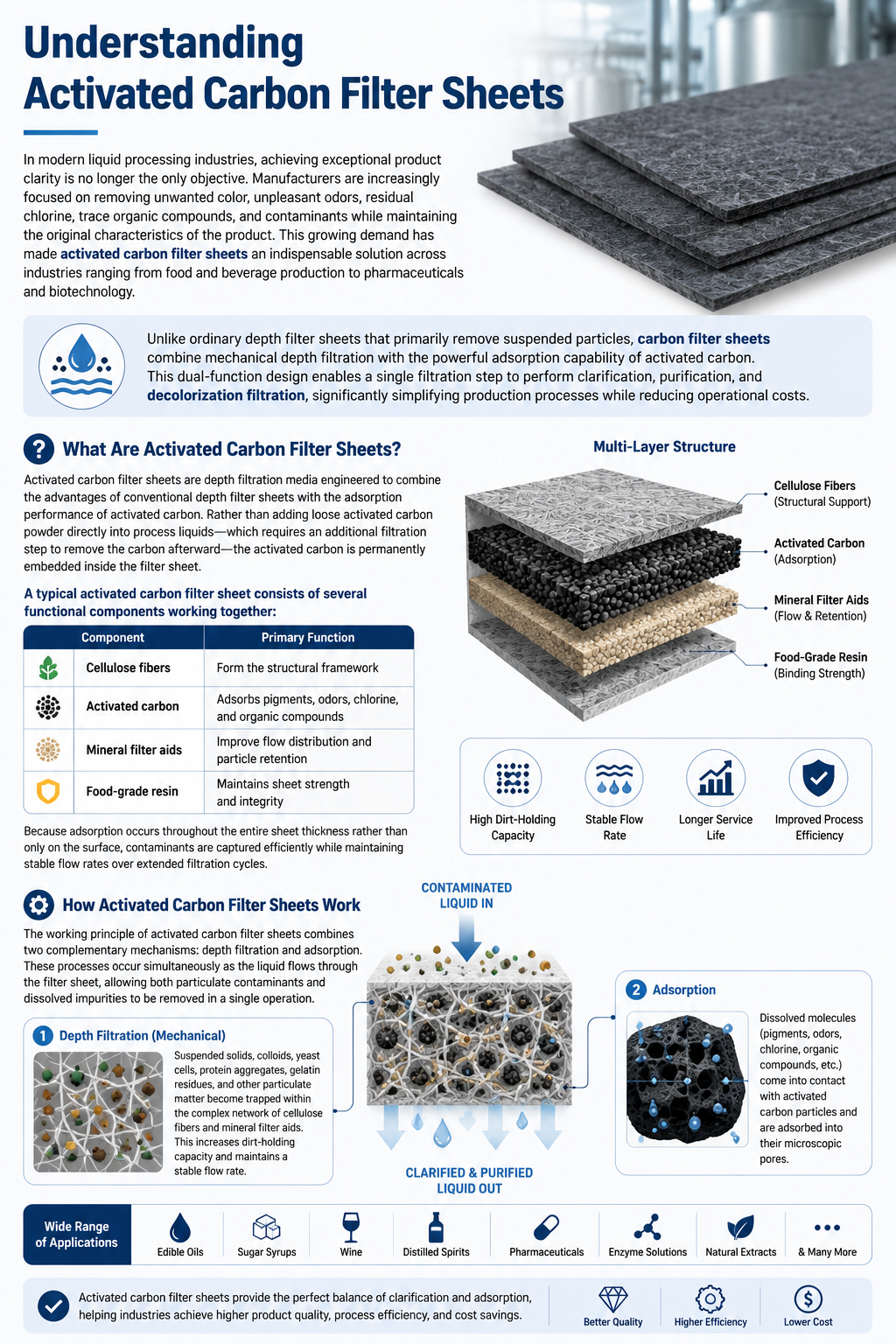
Unlike ordinary depth filter sheets that primarily remove suspended particles, carbon filter sheets combine mechanical depth filtration with the powerful adsorption capability of activated carbon. This dual-function design enables a single filtration step to perform clarification, purification, and decolorization filtration, significantly simplifying production processes while reducing operational costs.
Activated carbon filter sheets are manufactured by integrating carefully selected activated carbon powder into cellulose fibers, mineral filter aids, and food-grade binders. During production, these materials are compressed into a homogeneous filtration matrix with thousands of interconnected microscopic channels. This porous structure not only captures solid particles but also exposes the liquid to an enormous activated carbon surface area where adsorption occurs.
The effectiveness of activated carbon comes from its exceptionally high internal surface area, often exceeding 1,000 m² per gram depending on the carbon grade. Millions of microscopic pores attract and retain dissolved impurities through physical adsorption, allowing manufacturers to remove substances that traditional filtration media cannot capture. As a result, activated carbon filter sheets have become a preferred solution whenever simultaneous clarification and adsorption are required.
Today, these filter sheets are widely used for edible oils, gelatin, sugar syrups, wine, distilled spirits, pharmaceutical intermediates, enzyme solutions, natural extracts, and many other process liquids where both product appearance and purity are critical.
What Are Activated Carbon Filter Sheets?
Activated carbon filter sheets are depth filtration media engineered to combine the advantages of conventional depth filter sheets with the adsorption performance of activated carbon. Rather than adding loose activated carbon powder directly into process liquids—which requires an additional filtration step to remove the carbon afterward—the activated carbon is permanently embedded inside the filter sheet.
This integrated design offers several operational advantages. It minimizes carbon dust generation, reduces product loss, shortens processing time, and simplifies equipment cleaning. Manufacturers can achieve clarification and adsorption simultaneously without introducing extra handling steps, making production more efficient and consistent.
A typical activated carbon filter sheet consists of several functional components working together:
| Component | Primary Function |
| Cellulose fibers | Form the structural framework |
| Activated carbon | Adsorbs pigments, odors, chlorine, and organic compounds |
| Mineral filter aids | Improve flow distribution and particle retention |
| Food-grade resin | Maintains sheet strength and integrity |
Because adsorption occurs throughout the entire sheet thickness rather than only on the surface, contaminants are captured efficiently while maintaining stable flow rates over extended filtration cycles. This depth-loading capability also helps prevent premature clogging compared with surface filtration media.
The pore size, activated carbon loading, thickness, and density of the sheet can all be optimized for different industrial applications. High-carbon-content grades prioritize adsorption capacity, while balanced grades provide an ideal compromise between clarification efficiency and decolorization performance.
How Activated Carbon Filter Sheets Work
The working principle of activated carbon filter sheets combines two complementary mechanisms: depth filtration and adsorption. These processes occur simultaneously as the liquid flows through the filter sheet, allowing both particulate contaminants and dissolved impurities to be removed in a single operation.
The first stage is mechanical depth filtration. Suspended solids, colloids, yeast cells, protein aggregates, gelatin residues, and other particulate matter become trapped within the complex network of cellulose fibers and mineral filter aids. Unlike membrane filtration, which retains particles only on the surface, depth filtration distributes contaminants throughout the thickness of the media. This significantly increases dirt-holding capacity, extends service life, and maintains a stable flow rate.
The second stage is adsorption. As the liquid travels through the sheet, dissolved molecules come into contact with the activated carbon particles embedded inside the filtration matrix. The enormous internal pore structure of activated carbon creates countless adsorption sites capable of capturing pigments, phenolic compounds, chlorinated compounds, off-flavors, odor-causing molecules, residual processing chemicals, and various organic impurities.
This adsorption mechanism is particularly valuable in decolorization filtration applications. Colored compounds that remain dissolved after conventional clarification can be selectively adsorbed without substantially affecting desirable product components. Manufacturers can improve product appearance while preserving flavor, nutritional value, and chemical composition when the correct filter grade is selected.
The combination of mechanical retention and molecular adsorption explains why activated carbon filter sheets outperform conventional filter sheets in applications requiring both clarification and purification.
Types of Carbon Filter Sheets
Selecting the right carbon filter sheets is one of the most important decisions in any filtration process. Although all activated carbon filter sheets are designed to combine depth filtration with adsorption, different grades are engineered for specific production goals. Factors such as activated carbon content, pore structure, sheet density, thickness, and filtration efficiency determine how well a filter performs in different applications. Using a sheet with excessive adsorption capacity may unnecessarily remove desirable flavor compounds, while a sheet with insufficient adsorption may fail to achieve the required color reduction or odor removal.
Manufacturers generally classify activated carbon filter sheets according to their adsorption capability and filtration performance. Standard grades provide balanced clarification and adsorption, making them suitable for routine processing where moderate color correction and impurity removal are required. High-adsorption grades contain a larger proportion of activated carbon and are designed for applications involving intensive decolorization filtration, removal of trace contaminants, or elimination of unwanted aromas. Some manufacturers also offer specialty grades optimized for pharmaceutical processing, beverage production, or edible oil applications where product quality standards are especially stringent.
When evaluating different filter sheets, several technical parameters should be considered:
| Filter Sheet Type | Main Characteristics | Typical Applications |
| Standard Activated Carbon Filter Sheets | Balanced clarification and adsorption | Juice, syrup, gelatin, beverages |
| High-Adsorption Carbon Filter Sheets | Maximum decolorization and odor removal | Wine, spirits, natural extracts |
| Fine Filtration Carbon Sheets | High particle retention with moderate adsorption | Pharmaceutical solutions, enzyme filtration |
| Customized Carbon Filter Sheets | Tailored pore structure and carbon loading | Specialized industrial processes |
Another important consideration is filtration capacity. Higher carbon loading generally increases adsorption efficiency but may also reduce flow rate. Production managers therefore need to balance processing efficiency with product quality requirements. Laboratory filtration trials are often recommended before full-scale production to identify the most suitable filter grade.
Compatibility with existing filtration equipment is equally important. Most activated carbon filter sheets are designed for standard plate and frame filters, enclosed sheet filters, and modular filtration systems. Choosing sheets that match the filtration equipment helps ensure uniform sealing, stable differential pressure, and optimal filtration performance throughout the production cycle.
Food Industry Applications
The food industry demands filtration systems that not only produce visually appealing products but also preserve nutritional value, flavor, and safety. Activated carbon filter sheets have become an essential processing solution because they can simultaneously clarify liquids, remove unwanted color, eliminate off-odors, and reduce trace organic impurities. Their ability to combine filtration and adsorption into a single operation improves production efficiency while minimizing product handling.
One of the most common applications is sugar syrup processing. During sugar refining, syrups often contain colored compounds produced during extraction and thermal processing. Activated carbon filter sheets effectively perform decolorization filtration, removing these pigments without significantly affecting sugar concentration. The result is a brighter, cleaner syrup suitable for confectionery, beverage production, and food manufacturing.
Gelatin production is another industry where activated carbon filter sheets offer significant advantages. Gelatin solutions may contain residual pigments, proteins, lipids, and odor-causing compounds originating from raw materials. Integrated adsorption and depth filtration help improve clarity while reducing unwanted color and odor. High-quality gelatin is particularly important for food products, pharmaceutical capsules, and nutritional supplements where appearance directly influences customer perception.
Edible oil processing also benefits from carbon filtration. Although refining removes many impurities, residual oxidation products, trace pigments, and undesirable flavors may remain. Activated carbon filter sheets help polish the oil by adsorbing these remaining contaminants, contributing to improved color stability and longer shelf life without introducing additional filtration steps.
In beverage manufacturing, including fruit juice, tea drinks, plant-based beverages, and functional drinks, activated carbon filter sheets help remove haze-forming compounds, excess pigments, and off-flavors. Because adsorption occurs gradually throughout the sheet thickness, manufacturers can fine-tune filtration conditions to achieve the desired balance between purification and flavor preservation.
Food safety regulations have also increased the importance of reliable filtration technologies. Modern activated carbon filter sheets are manufactured using food-grade materials that comply with international standards for food contact applications. This ensures that filtration improves product quality without introducing contaminants into the final product.
As consumer demand continues shifting toward premium, naturally processed foods with clean labels, efficient filtration systems become even more valuable. Activated carbon filter sheets support these goals by reducing the need for excessive chemical treatments while consistently delivering attractive, high-quality finished products.
Wine Industry Applications
Among all beverage sectors, the wine industry places some of the highest demands on filtration performance. Winemakers must achieve microbiological stability, visual brilliance, and flavor consistency while preserving the unique characteristics developed during fermentation and aging. Activated carbon filter sheets play a specialized role in this process by providing selective adsorption alongside conventional depth filtration.
One of their primary uses is decolorization filtration. Certain wines may develop excessive coloration due to oxidation, raw material variation, or processing conditions. Activated carbon selectively adsorbs pigments responsible for undesirable color changes, allowing winemakers to restore visual quality without extensive chemical intervention. Careful selection of carbon filter sheet grades is essential, as excessive adsorption can remove beneficial aroma compounds along with unwanted pigments.
Odor correction is another important application. During fermentation or storage, wines occasionally develop undesirable aromas caused by sulfur compounds, oxidation by-products, or microbial activity. Activated carbon has excellent adsorption capacity for many volatile organic compounds responsible for these off-odors. Proper filtration helps improve the sensory profile while maintaining the wine’s essential character.
Activated carbon filter sheets are also used in the production of fruit wines, cider, distilled spirits, and specialty alcoholic beverages. These products may require color adjustment, removal of fermentation residues, or elimination of trace organic contaminants before bottling. Combining clarification and adsorption in one filtration step simplifies production and reduces product losses associated with multiple processing stages.
Winemakers must always balance purification with preservation. Every filtration process inevitably influences the final product to some degree. Laboratory-scale testing is therefore recommended before selecting a carbon filter sheet for commercial production. Pilot trials allow producers to evaluate color reduction, aroma retention, and overall sensory quality under actual production conditions.
Another advantage of integrated carbon filter sheets is operational cleanliness. Traditional powdered activated carbon treatments require separate dosing, mixing, settling, and removal operations. By embedding activated carbon directly within the filtration media, manufacturers eliminate these additional handling steps, reduce carbon dust, shorten production time, and improve process consistency.
As premium wine markets continue expanding globally, filtration technologies that enhance quality without compromising authenticity are becoming increasingly valuable. Activated carbon filter sheets provide winemakers with a practical solution for achieving attractive appearance, improved aroma, and consistent product quality while maintaining efficient production workflows.
Pharmaceutical Industry Applications
The pharmaceutical industry operates under some of the world’s strictest quality standards, making reliable filtration technologies absolutely essential. Every processing step must support product purity, batch consistency, and regulatory compliance. Activated carbon filter sheets are widely used throughout pharmaceutical manufacturing because they combine efficient particle removal with powerful adsorption of unwanted organic compounds.
One important application involves purification of active pharmaceutical ingredient (API) intermediates. During synthesis and purification, process liquids may contain residual color bodies, reaction by-products, catalysts, or trace organic contaminants. Activated carbon filter sheets help remove many of these impurities while simultaneously clarifying the solution, reducing the number of separate processing steps required before further purification.
Natural extracts used in pharmaceutical formulations also benefit from activated carbon filtration. Herbal extracts, fermentation products, enzymes, and biological solutions often contain pigments and odor-causing substances that need to be reduced without significantly affecting active components. Selecting the appropriate carbon filter sheet grade allows manufacturers to optimize purification while maintaining product efficacy.
The pharmaceutical industry also values the excellent cleanliness and operational safety of integrated carbon filtration. Unlike loose activated carbon powder, embedded carbon minimizes operator exposure, reduces dust generation, and simplifies equipment cleaning after production. These operational advantages support Good Manufacturing Practice (GMP) requirements while improving production efficiency.
Another important benefit is process reproducibility. Modern activated carbon filter sheets are manufactured under tightly controlled conditions to ensure consistent adsorption capacity, filtration performance, and mechanical strength from batch to batch. This consistency helps pharmaceutical manufacturers maintain validated production processes and satisfy regulatory documentation requirements.
Before implementation, pharmaceutical manufacturers typically perform compatibility studies to verify that filtration does not adversely affect active ingredients or critical quality attributes. Validation testing may include adsorption studies, extractables and leachables assessments, microbial retention evaluations, and filtration capacity measurements. These studies ensure that the selected filtration media consistently meet product specifications throughout commercial production.
With increasing demand for high-purity biologics, sterile intermediates, and advanced pharmaceutical formulations, activated carbon filter sheets continue to serve as a valuable processing technology. Their unique combination of clarification, adsorption, operational simplicity, and regulatory compatibility makes them an effective solution for many pharmaceutical filtration applications.
Advantages of Activated Carbon Filter Sheets
Choosing the right filtration media can have a significant impact on product quality, production efficiency, and overall operating costs. Activated carbon filter sheets offer a unique combination of depth filtration and adsorption, allowing manufacturers to perform clarification, purification, and decolorization filtration in a single processing step. This integrated approach has made them an indispensable solution in food, beverage, pharmaceutical, biotechnology, and fine chemical industries.
One of the greatest advantages is their dual-function filtration mechanism. Conventional depth filter sheets are excellent at removing suspended solids, but they cannot effectively eliminate dissolved impurities such as pigments, odors, residual chlorine, phenolic compounds, or trace organic contaminants. Activated carbon filter sheets solve this limitation by incorporating highly porous activated carbon directly into the filtration matrix. As liquid passes through the sheet, suspended particles are mechanically retained while dissolved molecules are simultaneously adsorbed onto the activated carbon’s extensive internal surface area.
Another major benefit is simplified processing. Traditional activated carbon treatment typically requires operators to add powdered activated carbon into a mixing tank, allow sufficient contact time, and then perform a separate filtration step to remove the carbon. This process increases labor requirements, product handling, equipment cleaning, and product losses. By integrating activated carbon into the filter sheet itself, manufacturers eliminate these extra operations, reducing production complexity while improving process consistency.
Product quality also improves significantly. Properly selected carbon filter sheets effectively reduce undesirable color, improve product clarity, eliminate unpleasant odors, and remove trace contaminants without excessive impact on desirable flavors or active ingredients. This balance is especially valuable in wine production, gelatin processing, pharmaceutical purification, and natural extract manufacturing, where preserving product characteristics is just as important as removing impurities.
Operational efficiency is another key advantage. Because contaminants are retained throughout the depth of the sheet rather than only on its surface, dirt-holding capacity is substantially higher than many surface filtration media. This allows longer filtration cycles, fewer filter changes, and improved productivity. Stable flow rates and lower pressure increases throughout filtration also contribute to more predictable manufacturing operations.
The environmental benefits should not be overlooked. Integrated activated carbon filtration reduces the handling of loose carbon powder, minimizing dust generation and workplace contamination. It also decreases wastewater associated with equipment cleaning and lowers the amount of filtration waste generated during production. Combined with fewer processing steps and lower product losses, these improvements contribute to more sustainable manufacturing practices.
The following table summarizes the primary advantages:
| Advantage | Benefit |
| Combined filtration and adsorption | Clarification and purification in one step |
| Efficient decolorization filtration | Removes pigments while maintaining product quality |
| Odor and taste improvement | Eliminates undesirable volatile compounds |
| Reduced product loss | No need for separate carbon dosing and removal |
| Longer service life | High dirt-holding capacity through depth filtration |
| Simplified operation | Fewer processing steps and easier cleaning |
| Improved production consistency | Stable filtration performance between batches |
| Compatible with standard filter presses | Easy integration into existing production lines |
For manufacturers seeking higher product quality, lower operating costs, and streamlined production, activated carbon filter sheets provide a practical and highly efficient solution that continues to gain popularity across a wide range of industries.
How to Choose the Right Activated Carbon Filter Sheets
Selecting the most suitable activated carbon filter sheets requires a thorough understanding of both the filtration process and the characteristics of the liquid being processed. Although many filter sheets appear similar, differences in carbon loading, pore structure, filtration efficiency, and adsorption capacity can significantly influence production performance and final product quality.
The first factor to consider is the filtration objective. If the primary goal is clarification, a balanced-grade carbon filter sheet with moderate adsorption capacity is often sufficient. When intensive decolorization filtration or odor removal is required, a higher activated carbon loading may be more appropriate. Understanding whether the process focuses on particle removal, color reduction, taste improvement, or contaminant adsorption helps narrow the selection.
Product characteristics also play a critical role. Liquids with high viscosity, such as gelatin or concentrated syrup, generally require filter sheets designed to maintain acceptable flow rates under challenging operating conditions. In contrast, low-viscosity beverages or pharmaceutical solutions may prioritize finer particle retention and higher adsorption efficiency. Temperature, pH, and chemical compatibility should also be evaluated, as these factors can influence adsorption performance and filtration stability.
Another important consideration is adsorption selectivity. Activated carbon does not distinguish between desirable and undesirable molecules—it adsorbs compounds based on their molecular properties. Excessive adsorption may unintentionally remove flavor compounds, pigments, nutrients, or active pharmaceutical ingredients. This is why laboratory-scale filtration trials are strongly recommended before commercial production. Small-scale testing allows manufacturers to optimize filtration conditions while protecting product quality.
Equipment compatibility is equally important. Most carbon filter sheets are designed for standard plate-and-frame filters, enclosed sheet filtration systems, and modular filtration units. Proper installation ensures uniform sealing, prevents bypass leakage, and maximizes filtration efficiency. Operators should also monitor differential pressure throughout filtration, replacing filter sheets when pressure reaches the manufacturer’s recommended limits rather than waiting for complete blockage.
Quality certifications should never be overlooked. For food and beverage applications, filter sheets should comply with relevant food-contact regulations. Pharmaceutical manufacturers should select media produced under rigorous quality management systems with comprehensive documentation supporting regulatory compliance. Traceability, batch consistency, and validated manufacturing processes all contribute to reliable long-term performance.
The table below summarizes key selection criteria:
| Selection Factor | Recommendation |
| Filtration objective | Clarification, odor removal, or decolorization |
| Carbon loading | Higher loading for stronger adsorption |
| Liquid viscosity | Match sheet permeability to process conditions |
| Product sensitivity | Conduct pilot testing to protect flavor or active ingredients |
| Equipment compatibility | Confirm dimensions and sealing requirements |
| Regulatory compliance | Select food-grade or pharmaceutical-grade products |
| Production volume | Balance filtration capacity with operating efficiency |
Common mistakes when selecting activated carbon filter sheets include choosing the highest adsorption grade without evaluating product impact, ignoring pressure limitations, overlooking compatibility with existing equipment, and skipping pilot-scale testing. Avoiding these errors can significantly improve both filtration performance and production economics.
Working closely with an experienced filtration supplier can further simplify the selection process. Technical experts can recommend suitable grades based on product characteristics, process requirements, and desired filtration results, reducing trial-and-error during production startup.
Conclusion
As production standards continue to rise across food, beverage, wine, pharmaceutical, and biotechnology industries, manufacturers require filtration technologies that deliver far more than simple particle removal. Activated carbon filter sheets have become an advanced processing solution by combining efficient depth filtration with powerful adsorption in a single filtration step. This unique design enables simultaneous clarification, purification, odor reduction, and decolorization filtration, helping manufacturers improve product appearance, consistency, and overall quality while simplifying production workflows.
Whether processing gelatin, edible oils, sugar syrups, fruit juices, wine, pharmaceutical intermediates, or natural extracts, selecting the appropriate carbon filter sheets can significantly enhance production efficiency and reduce operational costs. Careful consideration of product characteristics, adsorption requirements, filtration objectives, and equipment compatibility ensures the best possible results while preserving valuable product properties.
As consumer expectations and regulatory standards continue to evolve, integrated filtration solutions will play an increasingly important role in modern manufacturing. Investing in high-quality activated carbon filter sheets not only improves current production performance but also provides manufacturers with greater flexibility to meet future quality demands and process innovations.
Frequently Asked Questions
- What are activated carbon filter sheets used for?
Activated carbon filter sheets are used for simultaneous clarification and adsorption in liquid processing. They remove suspended particles, pigments, odors, chlorine, phenolic compounds, and other trace organic impurities in industries such as food, beverages, wine, pharmaceuticals, biotechnology, and fine chemicals.
- How do activated carbon filter sheets perform decolorization filtration?
During decolorization filtration, dissolved colored compounds come into contact with activated carbon embedded inside the filter sheet. These pigments are adsorbed onto the carbon’s highly porous surface while suspended solids are retained by the depth filtration structure, resulting in a clearer and lighter-colored product.
- Can carbon filter sheets replace powdered activated carbon?
In many applications, yes. Because activated carbon is already integrated into the filtration media, carbon filter sheets eliminate the need for separate carbon dosing, mixing, settling, and carbon removal steps. This simplifies processing, reduces product loss, and minimizes equipment cleaning.
- How do I choose the right activated carbon filter sheet?
Selection depends on several factors, including the filtration objective, required adsorption capacity, liquid viscosity, product sensitivity, operating conditions, equipment compatibility, and regulatory requirements. Pilot-scale filtration trials are recommended to determine the optimal filter grade for your process.
- Which industries benefit most from activated carbon filter sheets?
Industries that commonly use activated carbon filter sheets include food processing, edible oil refining, gelatin manufacturing, wine and spirits production, fruit juice processing, pharmaceutical manufacturing, biotechnology, enzyme production, natural extracts, cosmetics, and specialty chemical processing.
Post time: Jul-22-2026