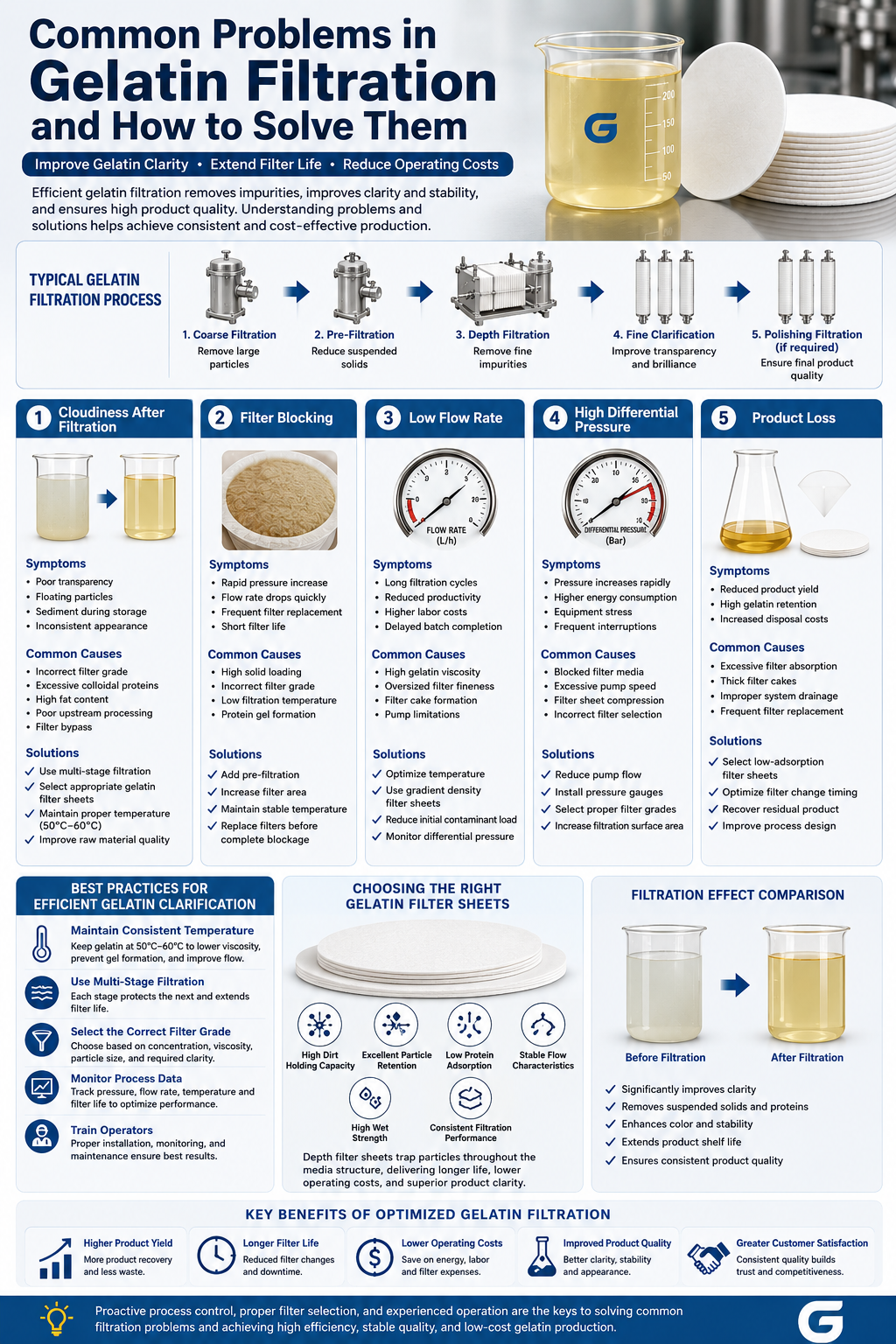
Gelatin is one of the most widely used ingredients in the food, pharmaceutical, nutraceutical, and cosmetic industries. Whether it is used for gummy candies, soft capsules, dairy products, desserts, collagen peptides, or pharmaceutical formulations, product quality depends heavily on an efficient gelatin filtration process.
Filtration not only removes suspended solids but also improves clarity, color, stability, and shelf life. However, gelatin is a challenging material to filter because of its high viscosity, protein content, and temperature sensitivity. Many manufacturers experience recurring filtration issues that reduce production efficiency and increase operating costs.
The most common problems include:
- Cloudiness after filtration
- Filter blocking
- Low flow rate
- High differential pressure
- Excessive product loss
Fortunately, these issues can usually be solved through proper process design, selecting suitable gelatin filter sheets, and optimizing filtration parameters.
This guide explains each problem in detail and provides practical solutions for improving gelatin clarification performance.
Understanding Gelatin Filtration
Before discussing troubleshooting methods, it is important to understand why gelatin is difficult to filter.
Gelatin is produced by partial hydrolysis of collagen extracted from animal tissues such as bovine hides, porcine skin, or fish skin. During production, the gelatin solution contains various impurities, including:
- Protein aggregates
- Fat residues
- Mineral particles
- Fine suspended solids
- Insoluble collagen fragments
- Processing additives
Without effective gelatin clarification, these impurities can negatively affect:
- Product appearance
- Taste
- Stability
- Filling equipment
- Capsule production
- Downstream membrane filtration
A typical gelatin filtration process includes:
- Coarse filtration
- Pre-filtration
- Depth filtration
- Fine clarification
- Final polishing (if required)
Among these stages, gelatin filter sheets play a critical role because depth filtration removes both visible and microscopic particles while maintaining high product quality.
Problem 1: Cloudiness After Gelatin Filtration
Symptoms
Even after filtration, the gelatin solution remains hazy or cloudy.
Manufacturers may observe:
- Poor transparency
- Floating particles
- Sediment during storage
- Inconsistent product appearance
This is one of the most common issues in gelatin clarification.
Possible Causes
- Incorrect Filter Grade
Using filter sheets with pores that are too large allows fine particles to pass through.
- Excessive Colloidal Proteins
Very fine protein particles are often much smaller than visible suspended solids.
- High Fat Content
Residual fats can create emulsions that appear cloudy.
- Poor Upstream Processing
Incomplete extraction or inadequate settling leaves too many impurities entering the filtration system.
- Filter Bypass
Improper installation may allow unfiltered liquid to bypass the filter media.
Solutions
Use Multi-Stage Filtration
Instead of relying on one filtration stage, manufacturers should progressively remove particles.
Typical sequence:
- Coarse filter
- Medium clarification
- Fine clarification
This significantly reduces filter loading.
Select Appropriate Gelatin Filter Sheets
Depth filter sheets with graded pore structures capture particles throughout the filter thickness instead of only on the surface.
Benefits include:
- Better clarification
- Longer service life
- Improved particle retention
Maintain Proper Filtration Temperature
Gelatin viscosity changes dramatically with temperature.
Recommended operating temperatures generally range between:
50°C–60°C
This range keeps viscosity low while preventing gelatin degradation.
Improve Raw Material Quality
Reducing incoming impurities decreases filtration difficulty and improves clarity.
Problem 2: Filter Blocking
Symptoms
Operators often notice:
- Rapid pressure increase
- Flow rate drops quickly
- Frequent filter replacement
- Short filter life
Filter blocking is one of the largest operating expenses in gelatin production.
Why Does Filter Blocking Occur?
Unlike rigid particles, gelatin impurities are soft and compressible.
They tend to:
- Build dense filter cakes
- Compress under pressure
- Reduce filter permeability
Additionally, proteins can gradually clog internal pores.
Common Causes
High Solid Loading
Excessive suspended solids overload the filter media.
Incorrect Filter Grade
Very fine filter sheets used too early in the process clog rapidly.
Low Filtration Temperature
Cooler gelatin becomes more viscous, reducing flow through the filter.
Protein Gel Formation
Partial gelation can occur if temperature fluctuates during production.
Solutions
Add Pre-Filtration
Increase Filter Area
- Longer production cycles
- Lower pressure rise
- Higher throughput
Maintain Stable Temperature
Replace Filters Before Complete Blockage
Problem 3: Low Flow Rate
Symptoms
- Long filtration cycles
- Reduced equipment productivity
- Higher labor costs
- Delayed batch completion
Possible Causes
High Gelatin Viscosity
Oversized Filter Fineness
Filter Cake Formation
Pump Limitations
Solutions
Optimize Temperature
Use Gradient Density Filter Sheets
- Higher dirt holding capacity
- Stable flow
- Longer filtration cycles
Reduce Initial Contaminant Load
Monitor Differential Pressure
Problem 4: High Differential Pressure
Symptoms
- Pressure increases rapidly
- Pump energy consumption rises
- Filter housings experience higher stress
- Frequent production interruptions
Common Causes
Blocked Filter Media
Excessive Pump Speed
Filter Sheet Compression
Incorrect Filter Selection
Solutions
Reduce Pump Flow
Install Pressure Gauges
Select Proper Filter Sheet Grades
Increase Filtration Surface Area
Problem 5: Product Loss
Symptoms
- Reduced product yield
- High gelatin retention in filters
- Increased waste disposal costs
Causes
Excessive Filter Absorption
Thick Filter Cakes
Improper System Drainage
Frequent Filter Replacement
Solutions
Select Low-Adsorption Gelatin Filter Sheets
Optimize Filter Change Timing
Recover Residual Product
Improve Process Design
Best Practices for Efficient Gelatin Clarification
Maintain Consistent Temperature
- Lower viscosity
- Higher flow rates
- Reduced filter blockage
Use Multi-Stage Filtration
| Stage | Purpose |
| Coarse Filtration | Remove large particles |
| Pre-Clarification | Reduce suspended solids |
| Fine Clarification | Improve transparency |
| Polishing | Final product quality |
Select the Correct Filter Grade
- Gelatin concentration
- Viscosity
- Particle size
- Production capacity
- Required clarity
Monitor Process Data
- Inlet pressure
- Outlet pressure
- Differential pressure
- Flow rate
- Temperature
- Batch volume
- Filter life
Train Operators
- Correct filter installation
- Pressure monitoring
- Filter replacement procedures
- Cleaning protocols
- Temperature control
Choosing the Right Gelatin Filter Sheets
- High dirt-holding capacity
- Excellent particle retention
- Low protein adsorption
- Stable flow characteristics
- High wet strength
- Consistent filtration performance
Conclusion
Post time: Jul-21-2026