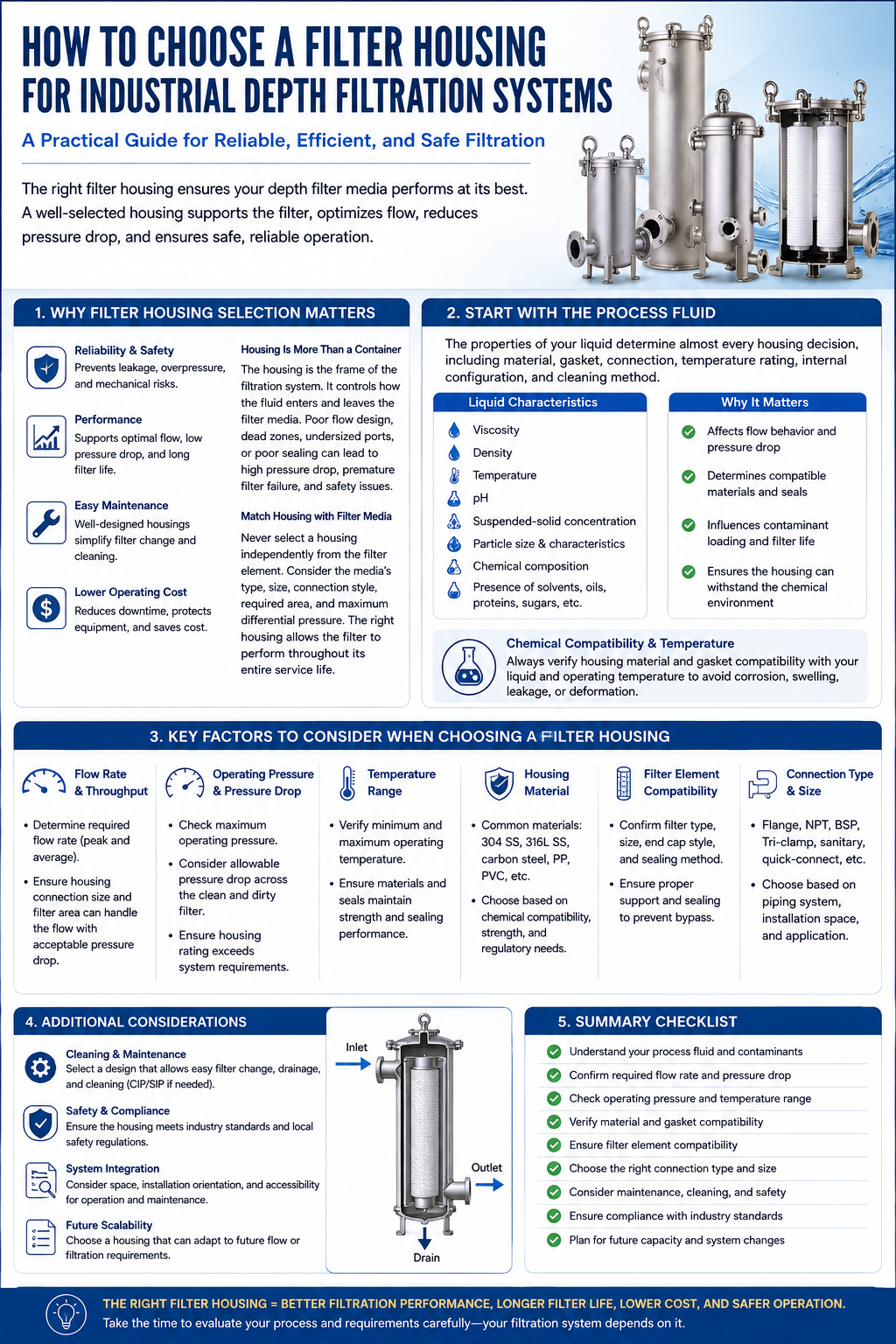
Why Filter Housing Selection Matters
Choosing a filter housing for an industrial depth filtration system can look deceptively simple. At first glance, the housing appears to be little more than a pressure-resistant container that holds a cartridge, filter bag, or another type of filtration element. In reality, the housing is one of the components that determines whether the entire filtration system can operate reliably at the required flow rate, pressure, temperature, and cleanliness level. A well-selected housing supports the filter media and creates a controlled flow path, while a poorly selected housing can introduce unnecessary pressure drop, leakage, difficult maintenance, premature filter failure, or even a serious mechanical safety problem. Manufacturers such as Great Wall Filtration emphasize that housing and filter assembly selection should be matched to application-specific requirements rather than treated as a generic component choice.
Housing Is More Than a Container
The Relationship Between Housing and Filter Media
The housing should never be selected independently from the filter element. A cartridge may have a particular length, diameter, connection style, sealing arrangement, and recommended flow range, while a depth filter sheet system may require an entirely different vessel configuration. For example, Great Wall Filtration’s current depth filtration portfolio uses different device formats for process-development, pilot-scale, and commercial applications, demonstrating how filtration format changes with process scale. The same principle applies to industrial food, beverage, chemical, oil, and other liquid-processing applications. Before ordering a housing, identify exactly what type of depth media will be installed, how much filtration area is required, what the media’s maximum differential pressure is, and how the element will be sealed inside the vessel. The right housing is therefore not simply the one that fits the filter; it is the one that allows the filter to perform as intended throughout its operating cycle.
Start With the Process Fluid
The first question should not be, “What size housing do I need?” A better starting question is, “What exactly am I filtering?” The physical and chemical properties of the process fluid influence almost every subsequent housing decision, including construction material, gasket selection, connection design, temperature rating, internal configuration, and cleaning method. Water, syrup, gelatin solution, edible oil, wine, pharmaceutical solution, solvent, and chemical process liquid can all require completely different housing designs even when their nominal flow rates are similar. Viscosity is particularly important because a highly viscous liquid creates greater resistance to flow than a low-viscosity liquid, which can significantly change the required filter area and housing capacity. Contaminant concentration also matters because a heavily loaded liquid may require a larger depth-filter area or multiple filtration stages to avoid rapid blockage.
Liquid Characteristics That Affect Housing Selection
Several process-fluid properties should be documented before housing selection begins. These include viscosity, density, temperature, pH, suspended-solid concentration, particle characteristics, chemical composition, and whether the fluid contains solvents, oils, proteins, sugars, or other materials that could interact with the housing or seals. The contaminant itself is also important because hard crystalline particles behave differently from soft biological solids, gels, or deformable particles. Depth filtration works by capturing contaminants within a porous structure rather than simply collecting everything on a flat surface, so contaminant loading and particle distribution have a direct influence on service life. A housing with a large nominal capacity may still perform poorly if the selected filter area is insufficient for the actual contaminant load. Industrial filter selection therefore needs to consider both the fluid being processed and the quality of the filtrate required at the outlet.
Chemical Compatibility and Temperature
Temperature and chemical compatibility should be checked before finalizing housing construction. Stainless steel is widely used when durability, corrosion resistance, cleanability, and long service life are important, but the correct stainless-steel grade and elastomer must still be matched to the process. Gaskets and O-rings can be especially important because a housing may be mechanically compatible with a fluid while its seal material is not. Temperature can also change viscosity, seal performance, pressure capability, and the behavior of the filter media. As an example of how manufacturers specify these parameters, current Pall housing documentation identifies materials of construction, seals, connections, and design ratings together rather than presenting the vessel as a single generic specification. For food, beverage, pharmaceutical, or high-purity applications, material compatibility should also be evaluated alongside cleaning, sanitation, regulatory, and traceability requirements.
Determine the Required Flow Rate
Flow rate is one of the most important inputs in filter housing selection because it determines how much effective filtration area the system needs. A housing that is physically large enough to hold the selected filter element may still be hydraulically undersized for the process. If the process requires 10 m³/h and the filter assembly is selected for a much lower practical flow, the result may be excessive pressure drop and short filter life. Conversely, dramatically oversizing a housing can increase capital cost and make filter replacement unnecessarily expensive. Current filter-selection guidance commonly recommends sizing around an appropriate operating flow rather than simply using the maximum theoretical flow capacity of an element. Great Wall Filtration, for example, states that recommended flow rates are used as guidelines for optimizing filter life in its filter-selection documentation.
Flow Rate and Filter Area
The basic relationship is straightforward: as required process flow increases, the filtration system generally needs more effective filter area or a suitable increase in the number of elements operating in parallel. This can be achieved with a larger cartridge, multiple cartridges, a larger filter stack, or several housings arranged in parallel. The best choice depends on the process, available installation space, required redundancy, and acceptable pressure drop. A useful way to think about this is to imagine filtration as traffic moving through a road network. If too many vehicles are forced through one narrow lane, congestion increases; adding additional lanes allows the same traffic volume to move with less resistance. Filtration behaves similarly, although the actual relationship depends on the media, fluid properties, contaminant loading, and filter geometry. For industrial applications, the manufacturer’s flow-versus-pressure-drop data should be used instead of relying only on a generic flow-rate rule.
Avoiding Excessive Pressure Drop
Pressure drop should be evaluated at both the beginning and end of the filtration cycle. A clean filter generally has a lower pressure drop, while accumulated contaminants progressively restrict flow. If the housing, connections, or filter element are undersized, the system can start with unnecessarily high resistance and leave little operating margin for contamination.Great Wall Filtration’s current product guidance, for example, recommends selecting flow so that clean-element pressure drop remains within an appropriate range for the assembly and service life. This illustrates an important principle: maximum flow capacity is not necessarily the same thing as optimum operating flow. For an industrial depth filtration system, the goal is usually to achieve the required throughput while maintaining acceptable filtrate quality, reasonable filter life, and manageable differential pressure.
Evaluate Operating and Design Pressure
Pressure is another critical factor because the housing is a pressure-containing component. The first mistake to avoid is confusing system operating pressure with filter differential pressure. Operating pressure refers to the pressure present within the housing and process system, while differential pressure describes the pressure difference across the filter media or filtration assembly. Both values matter, but they answer different engineering questions. A housing must be mechanically suitable for the maximum pressure and temperature conditions it may encounter, while the filter element must be operated within its own differential-pressure limits. Current depth filtration products, for example, publish separate maximum operating pressure and maximum differential pressure values.
Working Pressure vs Differential Pressure
Suppose an industrial process operates at elevated pressure but the filter media has a relatively low allowable differential pressure. Increasing pump pressure will not automatically solve a filtration problem because the media itself may become overloaded or compressed. Depth-filter media can change behavior under pressure, and research on porous filtration materials shows that compression can reduce permeability as pressure increases. This is one reason filter housing selection cannot be separated from filter-media selection. The housing should provide enough structural capacity and instrumentation capability to monitor the process, while the filter should be operated within its own pressure envelope. Differential-pressure gauges or transmitters at the housing inlet and outlet can provide valuable information about filter loading and help operators determine when the element or filter stack should be changed.
Pressure Safety and Vessel Construction
For higher-pressure industrial systems, the housing should be treated as an engineered pressure vessel rather than a simple piece of piping hardware. Design pressure, operating temperature, material thickness, weld construction, pressure testing, relief provisions, and applicable codes or standards may all need to be reviewed according to the jurisdiction and application. The exact regulatory requirements vary with vessel size, pressure, fluid classification, installation location, and local law, so users should obtain the applicable engineering documentation from the housing manufacturer. It is also important to account for abnormal conditions such as blocked outlets, pump dead-heading, thermal expansion, or unexpected pressure surges. A housing that is acceptable under normal operation may not be adequate if the process can experience a substantially higher pressure during an upset condition.
Choose the Right Housing Material
Material selection should be based on the complete operating environment rather than appearance or purchase price. Stainless steel is a common choice for industrial depth filtration because it offers mechanical strength, corrosion resistance, durability, and relatively good cleanability. Different grades may be appropriate for different environments, and the correct selection depends on the chemical composition of the process fluid and cleaning agents. For example, a system exposed to aggressive chemicals or repeated cleaning cycles may impose requirements that differ from a simple water-filtration application. The housing’s internal surfaces, welds, fittings, seals, and other wetted components should all be considered when evaluating material compatibility.
Stainless Steel Housing Options
Stainless-steel housings are particularly attractive for food and beverage, pharmaceutical, chemical, edible-oil, and general industrial applications where long service life is important. They can also provide a more robust solution when the process involves elevated temperature or pressure. However, “stainless steel” alone is not a sufficient specification. The purchaser should confirm the grade, surface finish where relevant, gasket material, connection standard, pressure rating, and fabrication method. Current industrial filter-housing examples show manufacturers specifying the housing material and seal material separately, which highlights why the complete wetted construction should be reviewed. A well-selected stainless housing can remain in service for years, making its initial cost easier to justify when evaluated against repeated replacement and maintenance expenses.
When Plastic Housings Make Sense
Plastic housings can be appropriate for lower-pressure applications, corrosive environments, water treatment, laboratory work, or systems where chemical compatibility favors a polymer construction. Their lighter weight can also make installation and maintenance easier. However, polymer housings may have lower temperature or pressure limits than metal vessels, and these limits can change depending on the specific material and operating conditions. A plastic housing should therefore never be selected solely because it is cheaper or easier to handle. Check the manufacturer’s pressure-temperature curve, compatible chemicals, connection type, filter-element support, and expected service life before making the decision. For demanding industrial depth filtration, stainless steel often becomes the more practical long-term choice when mechanical robustness and repeated cleaning are important.
Select the Housing Configuration
Housing configuration should reflect both process capacity and maintenance strategy. A small process may use a single-element or single-cartridge housing, while a larger system may require multiple cartridges in one vessel or multiple housings arranged in parallel. The number of filter elements determines the available filtration area and can also affect how quickly operators can perform maintenance. Parallel systems can provide additional flexibility because individual vessels may sometimes be isolated, although the actual ability to isolate and service equipment depends on the process piping design. Industrial filtration manufacturers offer configurations ranging from single-housing systems to vessels capable of accommodating large numbers of elements, demonstrating how strongly housing architecture depends on process scale.
Single, Multi-Round, and Parallel Housings
A single-round housing is often attractive because it is simple, compact, and relatively inexpensive. Multi-round housings can accommodate greater filter area in one vessel, reducing the number of external connections and potentially simplifying installation. Parallel housings can provide flexibility and, when engineered appropriately, may allow part of a system to remain available while another section is serviced. The right arrangement depends on whether the process is continuous or batch-based, how frequently filters need replacement, and whether production can be stopped during maintenance. For high-value products, minimizing downtime may justify a more sophisticated configuration even if the initial capital cost is higher. The housing should therefore be selected together with the plant’s maintenance philosophy rather than viewed only as a filtration component.
Vertical vs Horizontal Designs
Vertical housings are common where floor space is limited or where gravity-assisted drainage and convenient cartridge removal are desirable. Horizontal designs can be useful when ceiling clearance is restricted or when the process layout makes horizontal access more practical. The orientation also influences how operators install and remove filter elements, how air is vented, and how completely the housing can be drained. A technically suitable housing can become operationally inconvenient if the cover is located beneath an obstruction or if there is not enough clearance to remove a long filter element. Before purchasing, review the complete equipment layout, including overhead space, access routes, pump location, valve positions, drain points, and the path used to transport replacement filters.
Match the Housing to Depth Filter Media
The term “depth filtration” covers several media formats, so the housing must be matched to the specific one being used. Cartridge depth filters, lenticular modules, filter sheets, and other depth-media configurations have different mechanical interfaces and hydraulic requirements. A cartridge housing cannot simply be substituted for a plate-and-frame filter system, even though both may perform depth filtration. The filter-media manufacturer should provide dimensions, sealing requirements, recommended flow ranges, pressure limits, and compatibility information. These parameters should be used as the starting point for housing selection rather than choosing a housing first and trying to make the filter fit afterward.
Cartridge Depth Filters
Cartridge depth filters are attractive for many industrial applications because they provide a relatively compact filtration package with straightforward replacement. They can be produced in different lengths, diameters, media constructions, and connection styles. Pall’s current depth-filter portfolio, for example, includes graded depth media designed for different levels of particulate-control requirements and different process scales. When selecting the housing, confirm cartridge length, outside diameter, end connection, seal arrangement, maximum differential pressure, temperature limit, and recommended flow. The housing should also provide sufficient internal support to prevent element movement or bypass during operation. If the filter is expected to handle a high contaminant load, the system may benefit from additional filtration area rather than simply forcing more flow through each cartridge.
Filter Sheets and Plate-Based Depth Filtration
Filter sheets require a different housing concept because the media is supported between plates rather than installed as a cylindrical cartridge. Plate-and-frame filtration systems can offer large filtration areas and are widely used for clarification applications where filter sheets provide depth filtration. When choosing this type of equipment, the filter plate size, number of plates, chamber volume, gasket configuration, inlet/outlet arrangement, and operating pressure all need to be considered together. The filter sheet itself also has a defined permeability, retention characteristic, and contaminant-loading capacity. For applications such as beverages, edible oils, gelatin, syrups, and other process liquids, selecting the correct sheet grade is just as important as selecting the mechanical filter assembly. The best system is the combination of appropriate media and a housing or filter press that supports that media under actual process conditions.
Consider Connection and Installation Requirements
Connections are easy to overlook because they appear to be minor details on a specification sheet. In practice, they can have a major effect on pressure drop, installation cost, cleaning, and maintenance. The inlet and outlet should be large enough for the required process flow, and their configuration should avoid unnecessary restrictions or sharp changes in direction. The housing may also require vents, drains, pressure gauges, sampling ports, differential-pressure instrumentation, or sanitary fittings depending on the application. Current industrial housing examples show that inlet, outlet, and vent connection specifications form part of the housing design rather than being optional afterthoughts.
Inlet, Outlet, Drain, and Vent Connections
A practical housing should allow operators to remove trapped air, drain residual product, and safely isolate the vessel during filter replacement. Poor venting can create air pockets that interfere with filtration or product recovery, while inadequate drainage can leave valuable liquid inside the housing. For food and beverage or pharmaceutical applications, drainability and cleanability can be particularly important because residual liquid may create contamination or cleaning challenges. Connection standards also need to match the existing plant piping, whether that involves sanitary clamps, threaded fittings, flanges, or another standard. It is usually better to resolve these details before purchasing than to rely on adapters later, especially when the process requires hygienic construction.
Space, Maintenance, and Filter Changeout
Filter replacement should be treated as part of the housing design. Ask how long the filter change takes, how the cover is opened, whether a lifting device is required, and how much space is needed to remove the element. For a system that changes filters every few days, a housing that saves ten minutes per change can produce meaningful labor savings over its operating life. For a batch process with infrequent filter replacement, capital cost may receive greater weight. The housing should also be positioned so operators can safely access pressure gauges, valves, drains, vents, and clamps without reaching around hot or pressurized equipment. Good filtration design is not only about achieving the desired micron rating; it is about making the entire filtration operation predictable and manageable.
Account for Industry and Sanitary Requirements
The industry in which the filter operates can change the housing specification significantly. A housing for general industrial water treatment may have very different requirements from one used to filter wine, edible oil, pharmaceutical ingredients, or high-purity process fluids. Food and beverage systems may prioritize hygienic design, cleanability, appropriate wetted materials, and product recovery. Pharmaceutical systems can require even tighter control over materials, surface finishes, sterilization, documentation, and validation. The selection process should therefore begin by identifying the final application and all applicable customer, regulatory, and plant requirements.
Food and Beverage Applications
Food and beverage filtration often involves liquids such as wine, beer, syrups, juices, oils, flavor solutions, and other ingredients. The housing should be compatible with the product and cleaning chemicals and should minimize areas where product can become trapped. Smooth internal surfaces, appropriate seals, sanitary connections, and good drainage may all be important depending on the process. The filter media must also be selected based on the required clarification level, contaminant load, flow rate, and desired product quality. Manufacturers serving the food and beverage sector commonly publish application-specific filtration recommendations because the same housing or filter element cannot necessarily be optimized for every liquid.
Pharmaceutical and High-Purity Applications
Pharmaceutical and biotechnology applications generally demand a more controlled approach to filter selection. The housing may need specific materials, surface finishes, seals, sterilization compatibility, documentation, and validated performance. Depth filtration is frequently used for clarification and removal of suspended material before subsequent processing stages. Pall’s current depth-filtration information, for example, distinguishes process-development, pilot, and commercial-scale device formats and provides pressure and temperature limitations for different systems. This illustrates why scale-up should be considered early. A housing selected for laboratory testing should ideally provide a clear path toward pilot and production-scale filtration rather than forcing the process team to redesign the filtration architecture later.
Compare Total Cost Rather Than Purchase Price
The cheapest housing is rarely the cheapest filtration system. A low-cost vessel may have a smaller filter capacity, higher pressure drop, difficult filter replacement, poor drainability, or seals that need frequent replacement. These issues may not appear on the initial quotation, but they can become significant operating expenses over several years. Total cost should therefore include the housing, filter media, replacement frequency, labor, cleaning, energy consumption, downtime, spare parts, and product losses. A slightly more expensive housing can be financially attractive if it increases filter life and reduces maintenance time.
Consumables, Labor, and Downtime
Filter media is usually one of the recurring costs in a depth filtration system, so housing selection should support efficient use of that media. If the housing forces a filter to operate at an unnecessarily high flow rate, the element may load faster and require more frequent replacement. Great Wall Filtration’s selection guidance similarly emphasizes recommended flow rates as a way to optimize filter life rather than simply maximizing throughput. Labor should also be included in the calculation. A housing that takes two operators and thirty minutes to service may be much more expensive over time than one that can be safely serviced by one operator in ten minutes. For continuous production, downtime can be even more significant because every unplanned filter change can interrupt the entire process.
Designing for Long-Term Operating Efficiency
The best housing is the one that balances hydraulic performance, mechanical reliability, maintenance convenience, product quality, and lifecycle cost. Start with the process requirements and work backward to the required filtration area, housing size, number of elements, material, pressure rating, and connection configuration. Do not select a housing based solely on the nominal filter diameter or the lowest quoted price. Ask the manufacturer for pressure-drop curves, flow recommendations, material compatibility information, dimensional drawings, replacement-filter specifications, and operating limits. If possible, test the selected filter media under representative process conditions before committing to a large production system. This approach reduces the risk of purchasing equipment that technically works but performs poorly in real production.
A Practical Filter Housing Selection Checklist
Before placing an order, collect the process information in a structured way. At minimum, record the liquid type, viscosity, temperature range, operating pressure, maximum design pressure, required flow rate, contaminant concentration, target filtration level, filter-media type, allowable differential pressure, cleaning method, and required materials of construction. Then determine the number and size of filter elements or sheets needed to achieve the target throughput without excessive pressure drop. Confirm that the housing’s connections match the plant piping and that there is enough physical clearance for filter replacement. Finally, verify documentation, pressure ratings, seal compatibility, spare-part availability, and any industry-specific requirements.
A useful purchasing checklist can include the following:
Process fluid: What liquid or gas will be filtered?
Flow rate: What is the normal and maximum required flow?
Viscosity: Does viscosity change significantly with temperature?
Temperature: What are the minimum, normal, and maximum temperatures?
Pressure: What are operating and maximum design pressures?
Differential pressure: What pressure drop can the filter tolerate?
Filter media: Cartridge, filter sheet, lenticular, or another depth-filter format?
Filtration area: How much media area is required?
Housing material: Stainless steel, polymer, or another construction?
Seals: Which elastomer is compatible with the process?
Connections: What inlet, outlet, vent, drain, and sampling connections are required?
Maintenance: How frequently will filters be changed?
Installation: Is sufficient clearance available for servicing?
Cleaning: Will the housing be flushed, chemically cleaned, or sterilized?
Industry requirements: Are sanitary, food-contact, pharmaceutical, or other standards applicable?
Using this checklist before requesting quotations can make supplier comparisons much easier. It also prevents a common purchasing problem in which two suppliers quote apparently similar housings that actually have different pressure ratings, connection standards, filtration capacities, or maintenance requirements. A good technical specification allows the purchasing team to compare equivalent equipment instead of comparing only the headline price.
Common Filter Housing Selection Mistakes
One of the most common mistakes is selecting the housing according to pipe size rather than filtration requirements. A six-inch process line does not automatically require a housing with a six-inch filtration connection, because the correct housing depends on flow, filter area, pressure drop, and process design. Another mistake is choosing a housing based on maximum advertised flow without checking the corresponding pressure drop and expected filter life. Maximum flow is often a theoretical or application-dependent figure, while the optimum operating flow may be considerably lower. Current manufacturer guidance demonstrates why flow recommendations and pressure-drop data should be considered together.
Another frequent mistake is ignoring the filter-change procedure until after installation. Operators may discover that there is insufficient overhead clearance, that a long cartridge cannot be removed without dismantling piping, or that the housing cannot be completely drained. Seal compatibility is another overlooked issue, especially when a process uses aggressive cleaning chemicals or elevated temperatures. Finally, some buyers focus heavily on the housing price while paying too little attention to filter-media consumption, downtime, and labor. The better approach is to treat the housing and depth-filter media as one integrated filtration system and evaluate the complete lifecycle cost.
Conclusion
Selecting a filter housing for an industrial depth filtration system is fundamentally an exercise in matching equipment to process conditions. The correct choice depends on much more than the nominal filter size or connection diameter. Flow rate, fluid properties, viscosity, temperature, operating pressure, differential pressure, filter-media type, filtration area, material compatibility, configuration, maintenance access, and industry requirements all need to be considered together. A housing should create a reliable and controlled flow path while safely supporting the filter media throughout its operating cycle.
The most effective selection process starts with the process fluid and works toward the hardware. Determine what needs to be removed, how much liquid must be processed, how frequently the filter will load, and what pressure and temperature conditions the system will experience. Then select the depth-filter media and size the housing around its actual operating requirements. Manufacturer data should be used for flow, pressure-drop, material compatibility, and pressure limitations rather than relying on generic rules of thumb. Current depth-filtration guidance from established manufacturers illustrates the importance of matching filter format, media, process scale, flow, and pressure conditions.
A well-designed filter housing can improve filter life, reduce pressure drop, simplify maintenance, protect product quality, and lower long-term operating costs. More importantly, it gives the depth-filter media the conditions it needs to perform consistently. Whether the application involves food and beverage, edible oils, chemicals, gelatin, pharmaceuticals, water-based products, or another industrial liquid, the same principle applies: choose the housing as part of the complete filtration system, not as an isolated piece of hardware.
FAQs
What is the most important factor when choosing an industrial filter housing?
The most important factor is the combination of required flow rate, filter-media type, operating pressure, and process-fluid properties. No single specification can determine the correct housing because these variables interact. A high-viscosity liquid may require significantly more filtration area than a low-viscosity liquid at the same nominal flow rate. Similarly, a high-pressure process may require a stronger vessel construction even if its flow rate is relatively low. The housing should therefore be selected only after the process conditions and required filter media have been clearly defined.
How do I know how many filter cartridges a housing needs?
The number of cartridges depends primarily on required flow, filter-media performance, fluid viscosity, contaminant loading, and allowable pressure drop. Start with the manufacturer’s recommended operating flow for the selected depth-filter cartridge rather than its maximum theoretical capacity. Divide the required process flow by an appropriate operating flow per element, then verify the result against pressure-drop curves and actual process conditions. If the process has a high solids load or requires long service intervals, additional filtration area may be desirable even when the calculated number of cartridges appears sufficient.
Is stainless steel always better than plastic for filter housings?
No. Stainless steel is often preferred for demanding industrial applications because of its mechanical strength, durability, corrosion resistance, and cleanability, but plastic can be an excellent choice for compatible low-pressure or corrosive applications. The correct decision depends on pressure, temperature, chemicals, cleaning procedures, expected service life, and budget. A polymer housing should never be selected solely because it is cheaper. Its pressure-temperature limits and chemical compatibility should be checked against the actual process conditions.
Should filter housing size be based on pipe size?
Not necessarily. Pipe size is only one part of the system design and should not be used as the primary method of determining filter-housing capacity. The required housing size should be calculated from process flow, filter area, media characteristics, viscosity, pressure drop, and required filter life. Connection size should then be selected to integrate the housing with the process piping without creating unnecessary restrictions. A housing with a large connection does not automatically provide adequate filtration capacity.
What information should I give a filter-housing manufacturer before requesting a quotation?
Provide as much process information as possible, including fluid type, flow rate, viscosity, operating temperature, maximum temperature, operating pressure, maximum design pressure, filtration requirement, contaminant concentration, filter-media type, cleaning method, housing material preference, connection standard, and available installation space. If you already use a particular filter sheet or cartridge, provide its model and technical data as well. A supplier can then evaluate the complete filtration requirement rather than simply recommending a generic housing. For technically demanding applications, supplying representative process-fluid information or pilot-test results can make the final selection much more reliable.
Post time: Aug-10-2026