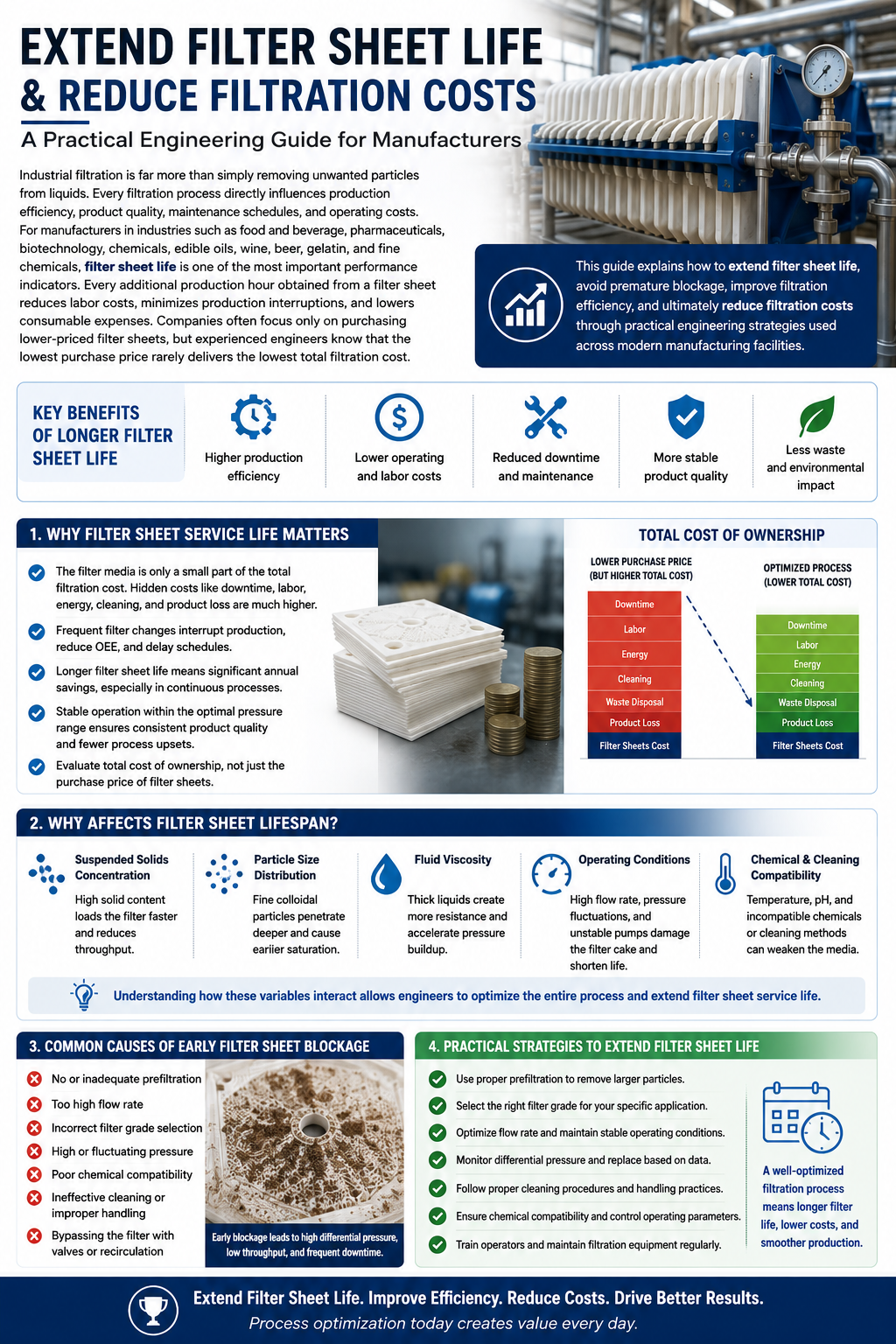
Industrial filtration is far more than simply removing unwanted particles from liquids. Every filtration process directly influences production efficiency, product quality, maintenance schedules, and operating costs. For manufacturers in industries such as food and beverage, pharmaceuticals, biotechnology, chemicals, edible oils, wine, beer, gelatin, and fine chemicals, filter sheet life is one of the most important performance indicators. Every additional production hour obtained from a filter sheet reduces labor costs, minimizes production interruptions, and lowers consumable expenses. Companies often focus only on purchasing lower-priced filter sheets, but experienced engineers know that the lowest purchase price rarely delivers the lowest total filtration cost.
Industry experts increasingly recommend optimizing the entire filtration process instead of concentrating on a single filtration component. Recent filtration guidance emphasizes that proper prefiltration, appropriate pressure control, and selecting the correct filter grade frequently generate greater savings than simply switching to cheaper filter media. A well-designed prefiltration stage can significantly reduce particle loading on the final filter, increasing throughput while reducing replacement frequency. Monitoring differential pressure rather than replacing filters according to fixed schedules also helps operators balance filter consumption with energy costs.
This guide explains how to extend filter sheet life, avoid premature blockage, improve filtration efficiency, and ultimately reduce filtration costs through practical engineering strategies used across modern manufacturing facilities.
Why Filter Sheet Service Life Matters
Many production managers evaluate filter sheets based only on purchase price, yet the filter media itself usually represents only a fraction of the total filtration expense. Hidden costs—including production downtime, labor for filter replacement, product loss during changeovers, cleaning procedures, and energy consumption caused by rising differential pressure—often exceed the cost of the filter sheets themselves.
When a filter sheet reaches the end of its service life too early, operators must stop production, depressurize the filtration system, replace the sheets, sanitize equipment if required, and restart the process. These repeated interruptions reduce overall equipment effectiveness (OEE) and can delay production schedules. In industries where production runs continuously, even a small increase in filter sheet service life may translate into thousands of dollars in annual savings.
Longer-lasting filter sheets also contribute to more stable product quality. A filtration system operating within its optimal pressure range delivers more consistent clarification, fewer fluctuations in flow rate, and lower risk of unexpected process failures. Rather than measuring filter performance only by the number of sheets consumed, manufacturers should evaluate the total cost of ownership, considering labor, energy, production downtime, waste disposal, and product recovery. This broader perspective often reveals that investing in process optimization delivers a much higher return than simply purchasing lower-cost consumables.
What Affects Filter Sheet Lifespan?
The lifespan of a filter sheet is determined by a combination of process conditions rather than a single variable. One of the biggest influences is the concentration of suspended solids entering the filtration system. Liquids containing high levels of particles naturally load the filter media faster, reducing throughput before differential pressure reaches the replacement point.
Particle size distribution is equally important. Fine colloidal particles are much more difficult to remove than larger suspended solids because they penetrate deeper into the filter matrix. When extremely fine particles dominate the feed stream, even high-capacity depth filter sheets may become saturated earlier than expected. Fluid viscosity also plays an important role. Thick liquids such as gelatin solutions, syrups, concentrated juices, and certain pharmaceutical products create higher resistance during filtration, accelerating pressure buildup across the filter media.
Operating conditions further determine filter sheet service life. Excessively high flow rates force contaminants deeper into the filter structure while increasing differential pressure. Likewise, pressure fluctuations caused by unstable pumps or improper valve operation can damage the filter cake that naturally forms during filtration. Chemical compatibility, operating temperature, pH, and cleaning procedures also affect media durability. Understanding how these variables interact allows engineers to optimize the entire process instead of repeatedly replacing filter sheets without addressing the root cause.
Common Causes of Early Filter Sheet Blockage
Premature blockage rarely results from poor filter quality alone. In most industrial applications, improper process design is responsible for the majority of early failures. One of the most common problems is introducing heavily contaminated liquids directly to fine filter sheets. Without removing larger particles first, the final filter rapidly becomes overloaded, dramatically reducing throughput.
Selecting the wrong filter grade is another frequent mistake. Choosing an extremely fine filter sheet simply because it produces clearer filtrate often backfires. Fine retention ratings reduce contaminant holding capacity, causing filters to plug much sooner. Instead, the filtration grade should match the actual particle size distribution rather than aiming for unnecessarily high clarification.
Operating beyond the recommended pressure range also shortens filter sheet life. Higher pressure does not always improve filtration performance. As differential pressure increases, contaminants become more tightly compacted within the filter media, restricting flow even further. Research on industrial filtration consistently shows that controlling pressure and monitoring differential pressure trends provides a better indication of filter replacement timing than relying on fixed operating hours.
Other common causes include inadequate system cleaning, air entrainment, sudden pressure shocks, poor filter installation, and inconsistent raw material quality. Each issue may seem minor individually, but together they significantly increase filtration costs throughout the year.
How Pre-Filtration Extends Filter Sheet Life
One of the most effective methods to extend filter sheet life is incorporating an appropriate pre-filtration stage. Rather than forcing the final filter sheet to capture every particle, a pre-filter removes larger contaminants before they reach the polishing filter. This staged approach distributes contaminant loading across multiple filtration layers, allowing each filter to perform within its optimal operating range.
Modern industrial filtration systems commonly use coarse depth filters, cartridge filters, bag filters, or sediment filters ahead of fine clarification sheets. The ideal pre-filter depends on particle size distribution, contaminant concentration, and desired product clarity. Industry guidance notes that a correctly selected prefilter often increases total throughput while lowering the overall filtration cost because the more expensive final filter requires replacement less frequently.
Multi-stage filtration also improves process stability. Instead of experiencing sudden pressure spikes caused by rapid filter blockage, contaminant loading becomes more gradual. Operators gain longer production cycles, fewer interruptions, and more predictable maintenance schedules. In many food, beverage, and pharmaceutical applications, pre-filtration pays for itself quickly through reduced filter consumption, higher productivity, and improved product consistency.
Selecting the Correct Filter Sheet Grade
Choosing the correct filter sheet grade is one of the most overlooked factors in maximizing filter sheet service life. Many users assume that a finer filter sheet automatically delivers better performance. While finer retention ratings can produce clearer filtrates, they also have lower dirt-holding capacity. This means the filter fills up much faster, leading to increased differential pressure, shorter production runs, and higher replacement frequency. Instead of selecting the finest available media, manufacturers should match the filter grade to the actual contamination profile of the liquid.
A proper filtration strategy begins by understanding the characteristics of the process fluid. Questions such as “What is the average particle size?”, “How much suspended solids are present?”, and “Is microbial reduction required?” help determine the most suitable filter sheet. Laboratory filtration trials are particularly valuable because they allow engineers to compare multiple grades before implementing them in full-scale production. Testing often reveals that a slightly coarser grade can achieve the required product clarity while processing significantly larger liquid volumes before replacement becomes necessary.
Depth filter sheets are available in a wide range of retention ratings and contaminant holding capacities. Coarse grades are designed for removing large particles and protecting downstream equipment. Medium grades provide efficient clarification for beverages, edible oils, gelatin solutions, and many chemical products. Fine grades target small particles, yeast cells, and polishing applications where product appearance is critical. Sterilizing grades are used when microbial reduction is essential, particularly in pharmaceutical and biotechnology manufacturing.
Another common mistake is attempting to solve every filtration challenge with a single filter sheet. Multi-stage filtration generally delivers better results. For example:
| Application | Recommended Filtration Strategy | Expected Benefit |
| Fruit Juice | Coarse Sheet → Fine Sheet | Longer filter life and better clarity |
| Wine | Medium Sheet → Fine Polishing Sheet | Reduced haze with higher throughput |
| Edible Oil | Pre-filter → Clarification Sheet | Lower operating cost |
| Gelatin | Coarse Clarification → Fine Polishing | Less blockage and improved yield |
| Pharmaceutical Liquids | Prefilter → Sterile Filter | Longer sterile filter service life |
Selecting the proper filter sheet grade also reduces product loss. Every filter change leaves residual liquid trapped inside the filter pack. If filters are replaced twice as often as necessary, the cumulative product loss can become significant, particularly when filtering high-value pharmaceutical ingredients, specialty chemicals, or premium beverages. Optimizing filter grade therefore improves both filtration efficiency and production profitability.
Best Operating Pressure for Maximum Service Life
Operating pressure has a direct influence on filter sheet life, yet many facilities mistakenly believe that increasing pressure will automatically increase filtration speed. In reality, filtration behaves very differently. During the early stage of filtration, increasing pressure may temporarily raise the flow rate. However, as contaminants accumulate within the filter matrix, excessive pressure compresses the filter cake, making it denser and more difficult for liquid to pass through. Eventually, flow rate decreases even though pump pressure continues to rise.
Most industrial filtration equipment manufacturers recommend operating within the pressure range specified for the filter sheets and housing system. Instead of chasing maximum pressure, operators should aim for stable differential pressure throughout the production cycle. Stable operating conditions prevent sudden particle breakthrough and minimize mechanical stress on the filter media.
Several best practices can significantly improve filtration performance:
- Start filtration at a moderate flow rate rather than full pump capacity.
- Avoid sudden pressure spikes during startup and shutdown.
- Monitor differential pressure continuously instead of relying only on elapsed operating time.
- Replace filter sheets when differential pressure reaches the manufacturer’s recommended limit rather than waiting for complete blockage.
- Ensure pumps are properly sized to avoid excessive pulsation.
Pressure monitoring also provides valuable diagnostic information. A rapidly increasing differential pressure often indicates excessive suspended solids in the feed stream or inadequate pre-filtration. A stable pressure profile suggests that the filtration process is well balanced. By analyzing pressure trends over multiple production batches, engineers can identify process improvements that consistently extend filter sheet life while reducing energy consumption.
Temperature should also be considered alongside pressure. Higher temperatures generally reduce liquid viscosity, allowing fluids to pass through the filter more easily. However, excessive temperatures may affect the mechanical strength of certain filter materials or alter product quality. Maintaining both temperature and pressure within recommended operating windows provides the most reliable balance between productivity and filter longevity.
Cleaning, Monitoring, and Preventive Maintenance
Although most depth filter sheets are disposable and not intended for repeated cleaning, proper maintenance of the surrounding filtration system is essential for maximizing their service life. Dirty filter housings, clogged distribution plates, damaged seals, and residual contamination left inside the filter press can all reduce filtration efficiency before a new set of filter sheets is even installed.
Routine inspection should begin before every production cycle. Operators should verify that filter plates are clean, evenly aligned, and free from scratches or deformation. Uneven compression across the filter stack may create bypass channels that allow contaminants to pass around the filter media instead of through it. This not only reduces product quality but also creates uneven loading, causing certain filter sheets to become blocked much earlier than others.
Monitoring production data is equally important. Facilities that record filtration parameters—including flow rate, inlet pressure, outlet pressure, differential pressure, processed volume, operating time, and product characteristics—can identify long-term trends that are impossible to detect through occasional observations. Digital monitoring systems now allow manufacturers to predict filter replacement intervals based on actual process performance rather than fixed maintenance schedules.
Preventive maintenance should include:
- Regular inspection of pumps and valves.
- Calibration of pressure gauges and sensors.
- Cleaning filter housings after every production batch.
- Replacing worn gaskets and sealing components.
- Verifying correct installation of filter sheets.
- Recording filter lifespan for each production campaign.
Operator training is another critical factor. Even the highest-quality filter sheets cannot compensate for improper installation or incorrect operating procedures. Training personnel to recognize abnormal pressure behavior, unusual flow reductions, or signs of improper filter seating helps prevent costly production disruptions.
Many leading manufacturers have adopted predictive maintenance strategies that combine sensor data with historical production records. Instead of waiting for filters to fail unexpectedly, maintenance teams schedule replacements during planned production stops. This approach minimizes downtime, improves resource planning, and contributes significantly to lower overall filtration costs.
Proper storage of unused filter sheets should not be overlooked. Sheets should be kept in their original packaging, protected from moisture, direct sunlight, dust, and strong odors. Exposure to unfavorable environmental conditions can alter the physical properties of cellulose-based filter sheets before they are ever installed, reducing their effectiveness once they enter service.
By combining proper maintenance, continuous monitoring, optimized operating conditions, and the correct filter selection, manufacturers can dramatically reduce filtration costs while achieving longer production cycles and more consistent product quality.
Conclusion
Increasing filter sheet service life is not simply about purchasing higher-quality filter media—it requires optimizing the entire filtration process. Every stage, from raw material preparation and pre-filtration to filter grade selection, pressure control, and preventive maintenance, contributes to overall filtration performance. Companies that focus only on filter price often overlook the much larger expenses associated with downtime, labor, energy consumption, and product loss.
The most successful manufacturers treat filtration as a system rather than an individual component. By selecting the appropriate filter sheet service life strategy, implementing effective pre-filtration, operating within recommended pressure ranges, and continuously monitoring process performance, businesses can significantly extend filter sheet life while maintaining consistent product quality.
Ultimately, reducing filtration costs is about making smarter operational decisions rather than simply spending less on consumables. A well-optimized filtration system delivers higher productivity, longer production runs, fewer interruptions, and a lower total cost of ownership—benefits that directly improve profitability across food, beverage, pharmaceutical, chemical, and industrial manufacturing operations.
Frequently Asked Questions
- How can I extend filter sheet life without changing filter materials?
You can often extend filter sheet life by improving pre-filtration, reducing suspended solids before final filtration, maintaining stable operating pressure, and avoiding excessive flow rates.
- What is the most common reason filter sheets become blocked early?
The most common cause is introducing liquids with high concentrations of suspended solids directly into fine filter sheets without adequate pre-filtration.
- Does higher pressure improve filtration performance?
Not necessarily. Excessive pressure can compress the filter cake, reduce flow rate, and shorten filter sheet service life. Stable differential pressure usually delivers better long-term performance.
- How do I choose the correct filter sheet grade?
The ideal grade depends on particle size distribution, required clarity, product viscosity, and process objectives. Laboratory filtration testing is the most reliable method for selecting the appropriate grade.
- Can preventive maintenance reduce filtration costs?
Yes. Regular equipment inspection, pressure monitoring, proper filter installation, and cleaning of the filtration system help maximize filter sheet life, minimize downtime, and lower overall operating costs.
Post time: Jul-24-2026