Why Edible Oil Filtration Matters
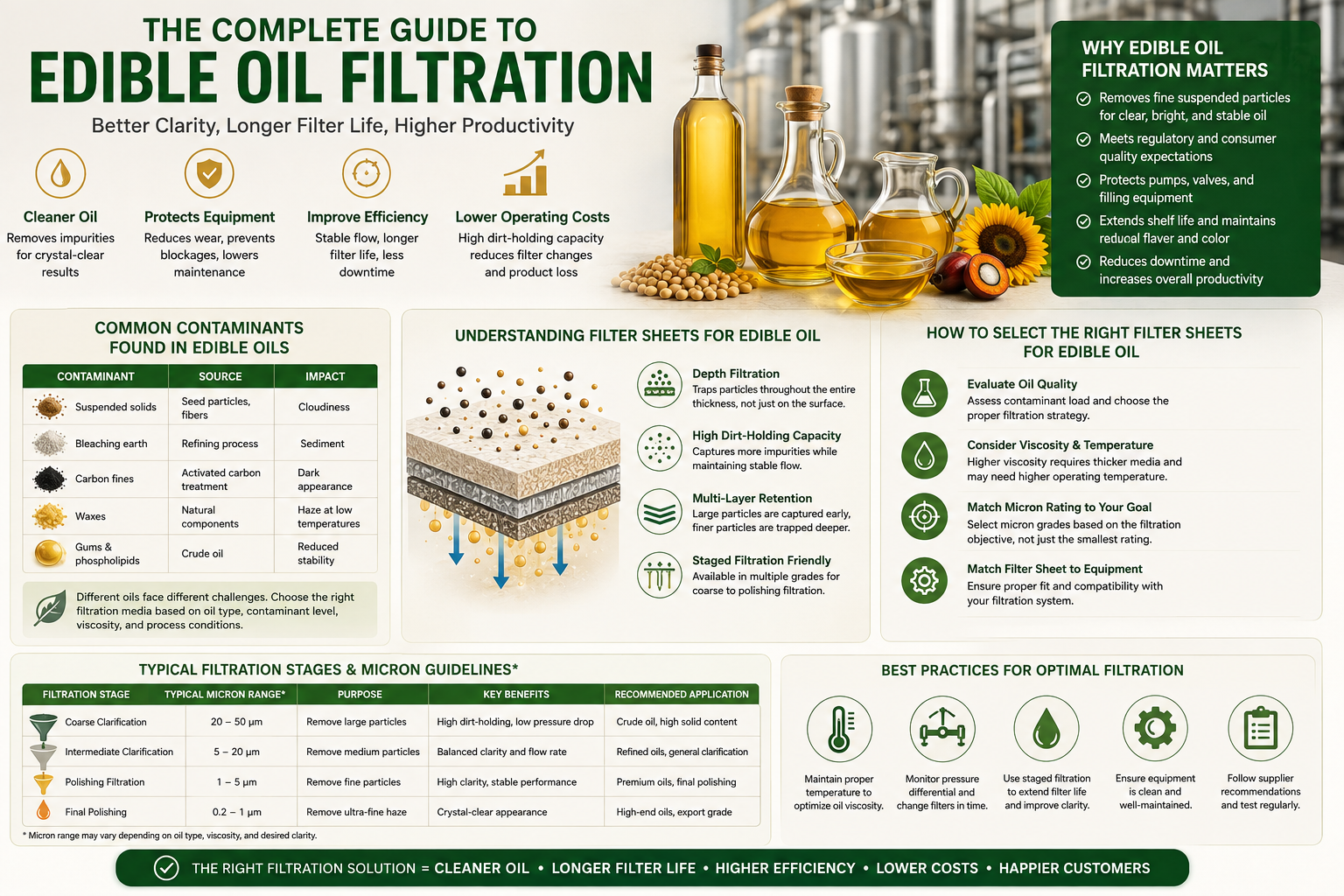
Whether producing soybean oil, sunflower oil, palm oil, peanut oil, sesame oil, or specialty vegetable oils, edible oil filtration is one of the final quality-control steps before packaging. Even after refining, bleaching, or deodorization, edible oils often contain fine suspended particles that affect appearance, stability, and shelf life. Proper edible oil clarification removes these impurities while preserving the natural characteristics of the oil.
Industrial processors today face increasing expectations from both regulators and consumers. Buyers expect crystal-clear cooking oil with consistent color, extended storage stability, and minimal sediment. Food manufacturers also require reliable filtration systems capable of operating continuously while minimizing downtime and product loss. Modern depth filter sheets for edible oil have therefore become a preferred solution because they combine high dirt-holding capacity with excellent clarification efficiency. Recent industry guidance emphasizes matching filter sheet grades to contaminant levels instead of simply choosing the finest available media, improving productivity while lowering operating costs.
Another important reason for cooking oil filtration is equipment protection. Removing abrasive particles before filling or storage helps reduce pump wear, prevents valve blockage, and lowers maintenance costs. When filtration is properly designed, manufacturers achieve cleaner products, longer filter service life, and higher production efficiency simultaneously.
Common Contaminants Found in Edible Oils
During oil extraction and refining, various contaminants remain suspended in the liquid. Some are visible to the naked eye, while others are microscopic particles that gradually create haze or sediment after storage. Understanding these contaminants is the first step toward selecting the correct filtration media.
Common contaminants include:
| Contaminant | Source | Impact |
| Suspended solids | Seed particles, fibers | Cloudiness |
| Bleaching earth | Refining process | Sediment |
| Carbon fines | Activated carbon treatment | Dark appearance |
| Waxes | Natural components | Haze at low temperatures |
| Gums & phospholipids | Crude oil | Reduced stability |
Different oils present different filtration challenges. Palm oil typically contains higher solid loads after refining, while sunflower oil and soybean oil may require polishing filtration to achieve premium clarity. Specialty oils such as sesame oil or grape seed oil often require carefully balanced filtration that removes impurities without stripping desirable flavor compounds. Industry manufacturers recommend selecting food-grade cellulose filter papers or depth filter sheets that comply with food-contact regulations and match oil viscosity.
Understanding Filter Sheets for Edible Oil
Unlike membrane filters that capture particles only on their surface, depth filter sheets for edible oil trap contaminants throughout the entire thickness of the media. Their structure is typically composed of cellulose fibers, mineral filter aids, and specialized binders that create a complex three-dimensional filtration pathway.
Imagine walking through a dense forest instead of an open field. Large particles become trapped immediately, medium particles travel deeper before being captured, and only the smallest contaminants continue moving through the structure. This multi-layer retention mechanism gives depth filter sheets significantly greater dirt-holding capacity than surface filters while maintaining stable flow rates over longer production cycles.
Another advantage is their flexibility. Manufacturers offer filter sheets in multiple retention grades ranging from coarse clarification to polishing filtration. Rather than relying on a single ultra-fine filter, processors often use staged filtration to maximize throughput and reduce differential pressure. Industry data shows that staged filtration consistently extends filter life while producing superior clarification results.
How to Select the Right Filter Sheets for Edible Oil
Selecting the right filter sheet involves much more than choosing the smallest micron rating. The optimal solution depends on oil type, contaminant concentration, required clarity, production volume, operating temperature, and filtration equipment.
Start by evaluating the incoming oil quality. Crude oils with heavy contaminant loads require coarse clarification before fine polishing. Refined oils may only need a polishing-grade sheet to remove residual haze-forming particles.
The second factor is viscosity. Higher-viscosity oils generally benefit from thicker filter media that provide adequate flow without excessive pressure drop. Temperature also affects viscosity, meaning the same oil may filter differently depending on process conditions.
Micron selection should always match the filtration objective.
| Filtration Stage | Typical Micron Range* | Purpose |
| Coarse | 10–20 μm | Remove large suspended solids |
| Medium | 5–10 μm | General clarification |
| Fine | 2–5 μm | Improve clarity |
| Polishing | 1–3 μm | Final bright filtration |
*Actual ratings vary by manufacturer. Always verify technical datasheets before final selection.
Finally, ensure compatibility with your plate-and-frame filter press or other filtration equipment. Proper sheet dimensions, sealing characteristics, and pressure ratings contribute just as much to successful filtration as the retention rating itself.
Improving Product Quality Through Proper Filtration
High-quality edible oil clarification directly influences consumer perception. Clear oil is often associated with freshness, purity, and premium quality. Although filtration does not improve the chemical composition of the oil, it significantly enhances visual appearance by removing haze-causing particles and residual processing materials.
Filtration also contributes to storage stability. Suspended solids may promote oxidation or settle during storage, creating unattractive deposits inside bottles. Removing these particles helps maintain a consistent appearance throughout the product’s shelf life.
Food safety represents another important consideration. Food-grade filter sheets manufactured from approved raw materials are designed specifically for edible applications. Many industrial-grade filtration papers comply with recognized food-contact standards such as FDA recommendations and European food-contact regulations. Choosing certified filtration media helps processors satisfy customer audits and regulatory requirements while maintaining confidence in product safety.
For premium edible oils marketed internationally, consistent filtration quality often becomes a competitive advantage. Buyers expect every batch to demonstrate identical clarity, making reliable filtration an essential component of modern quality management.
Cost Optimization Tips for Industrial Buyers
Reducing filtration costs is not simply about purchasing less expensive filter sheets. The true objective is minimizing the total cost of ownership while maintaining product quality.
One common mistake is selecting an extremely fine filter sheet as the primary filtration stage. Although this may initially produce excellent clarity, it frequently causes rapid clogging, shorter filter life, reduced throughput, and increased product loss. A staged filtration strategy usually delivers significantly better economics.
Key cost-saving practices include:
- Use coarse pre-filtration before polishing.
- Match micron rating to contaminant size.
- Replace filters based on pressure differential rather than fixed schedules.
- Conduct pilot filtration trials before large-scale production.
- Train operators to install filter sheets correctly.
Pilot testing deserves special attention. Even oils that appear similar may behave very differently because of variations in wax content, particle size distribution, or refining methods. A short filtration trial often identifies the most economical filter grade while avoiding expensive production disruptions later.
By balancing flow rate, clarification efficiency, and filter life, manufacturers can reduce consumable costs, decrease downtime, improve production capacity, and maximize oil recovery—all without compromising product quality. Industry experts consistently recommend optimizing the complete filtration sequence rather than focusing only on individual filter sheets.
Conclusion
Choosing the right filter sheets for edible oil is essential for producing high-quality cooking oils with excellent clarity, stability, and shelf life. The best filtration solution depends on the type of oil, contaminant load, required product quality, equipment configuration, and operating conditions.
Instead of assuming that finer filtration always produces better results, successful manufacturers build a balanced filtration strategy using appropriate micron ratings and multiple filtration stages. This approach improves edible oil filtration efficiency, reduces operating costs, extends filter life, and delivers a cleaner final product that meets modern food industry standards.
Investing time in proper filter sheet selection ultimately leads to higher productivity, better customer satisfaction, and lower overall production costs.
FAQs
- Why is edible oil clarification important?
It removes suspended solids, bleaching earth, carbon particles, waxes, and other impurities that affect clarity, stability, and shelf life.
- What micron rating is best for cooking oil filtration?
It depends on the application. Coarse filtration typically ranges from 10–20 μm, while polishing filtration often uses 1–3 μm media. Always verify the manufacturer’s specifications.
- Are depth filter sheets better than surface filters?
For most edible oil applications, yes. Depth filter sheets offer higher dirt-holding capacity, longer service life, and better clarification efficiency.
- Can filtration improve oil shelf life?
Yes. Removing suspended contaminants reduces sediment formation and helps maintain consistent product appearance during storage.
- How can I reduce filtration costs?
Use staged filtration, select the appropriate micron rating, monitor pressure differential, perform pilot testing, and choose food-grade filter sheets designed for your specific oil type.
Post time: Jul-30-2026