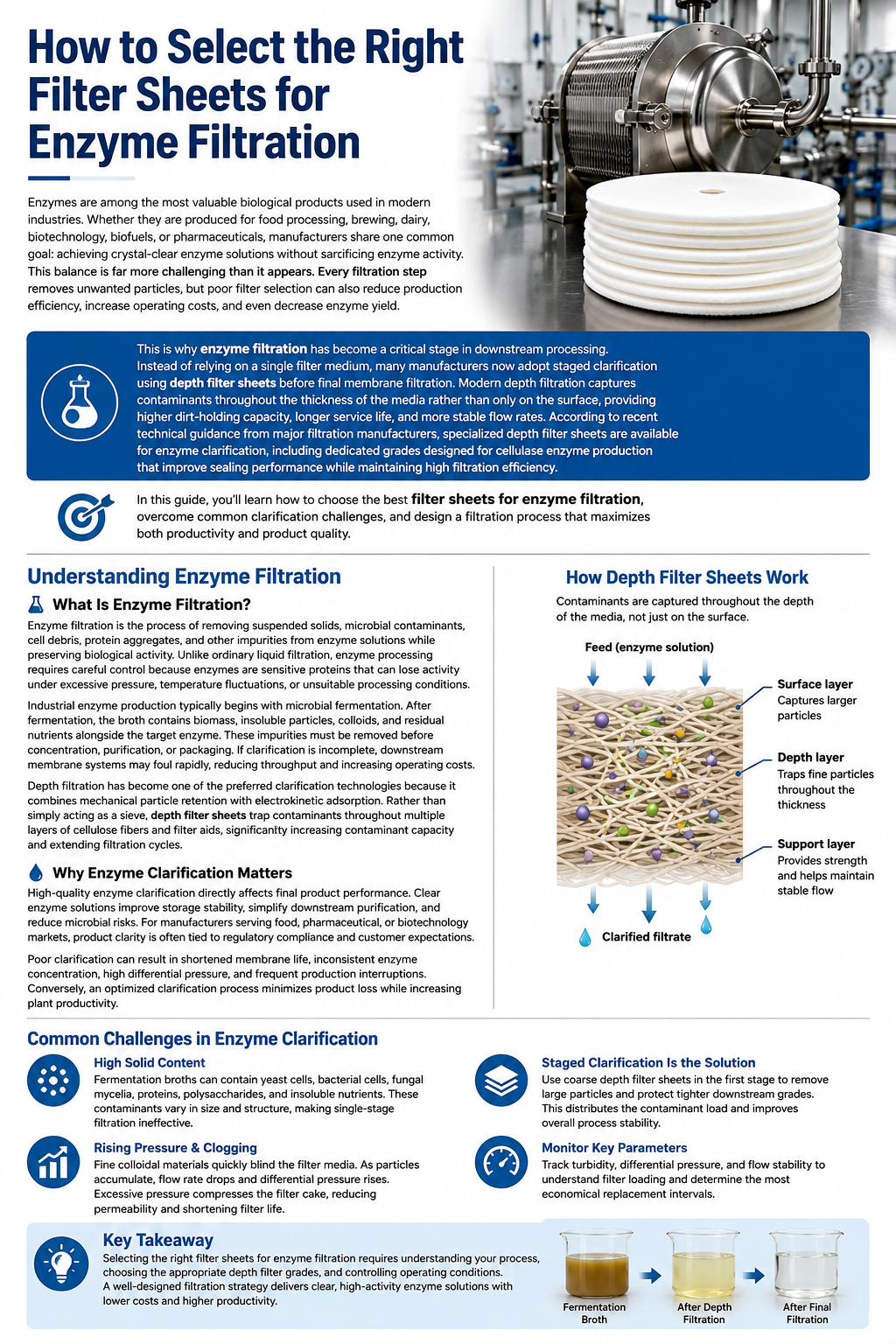
Enzymes are among the most valuable biological products used in modern industries. Whether they are produced for food processing, brewing, dairy, biotechnology, biofuels, or pharmaceuticals, manufacturers share one common goal: achieving crystal-clear enzyme solutions without sacrificing enzyme activity. This balance is far more challenging than it appears. Every filtration step removes unwante d particles, but poor filter selection can also reduce production efficiency, increase operating costs, and even decrease enzyme yield.
This is why enzyme filtration has become a critical stage in downstream processing. Instead of relying on a single filter medium, many manufacturers now adopt staged clarification using depth filter sheets before final membrane filtration. Modern depth filtration captures contaminants throughout the thickness of the media rather than only on the surface, providing higher dirt-holding capacity, longer service life, and more stable flow rates. According to recent technical guidance from major filtration manufacturers, specialized depth filter sheets are available for enzyme clarification, including dedicated grades designed for cellulase enzyme production that improve sealing performance while maintaining high filtration efficiency.
In this guide, you’ll learn how to choose the best filter sheets for enzyme filtration, overcome common clarification challenges, and design a filtration process that maximizes both productivity and product quality.
Understanding Enzyme Filtration
What Is Enzyme Filtration?
Enzyme filtration is the process of removing suspended solids, microbial contaminants, cell debris, protein aggregates, and other impurities from enzyme solutions while preserving biological activity. Unlike ordinary liquid filtration, enzyme processing requires careful control because enzymes are sensitive proteins that can lose activity under excessive pressure, temperature fluctuations, or unsuitable processing conditions.
Industrial enzyme production typically begins with microbial fermentation. After fermentation, the broth contains biomass, insoluble particles, colloids, and residual nutrients alongside the target enzyme. These impurities must be removed before concentration, purification, or packaging. If clarification is incomplete, downstream membrane systems may foul rapidly, reducing throughput and increasing operating costs.
Depth filtration has become one of the preferred clarification technologies because it combines mechanical particle retention with electrokinetic adsorption. Rather than simply acting as a sieve, depth filter sheets trap contaminants throughout multiple layers of cellulose fibers and filter aids, significantly increasing contaminant capacity and extending filtration cycles.
Why Enzyme Clarification Matters
High-quality enzyme clarification directly affects final product performance. Clear enzyme solutions improve storage stability, simplify downstream purification, and reduce microbial risks. For manufacturers serving food, pharmaceutical, or biotechnology markets, product clarity is often tied to regulatory compliance and customer expectations.
Poor clarification can result in shortened membrane life, inconsistent enzyme concentration, high differential pressure, and frequent production interruptions. Conversely, an optimized clarification process minimizes product loss while increasing plant productivity.
Common Challenges in Enzyme Clarification
High Solid Content
One of the biggest obstacles to enzyme filtration is handling fermentation broths with exceptionally high solid loads. Depending on the microorganism, fermentation medium, and production method, enzyme suspensions may contain yeast cells, bacterial cells, fungal mycelia, proteins, polysaccharides, and insoluble nutrients. These contaminants vary significantly in both size and structure, making them difficult to remove using a single filtration stage.
Large particles are generally easy to capture during coarse filtration, but fine colloidal materials often remain suspended and quickly blind the filter media. As these particles accumulate, flow rates decline while differential pressure rises. Operators frequently compensate by increasing pump pressure, but excessive pressure can compress the filter cake, further reducing permeability and shortening filter life. The result is more frequent filter sheet replacement, higher production costs, and lower overall throughput.
A practical solution is to divide clarification into multiple filtration stages rather than expecting one filter sheet to remove every contaminant. Coarse depth filter sheets with high dirt-holding capacity remove large particles during the first stage, protecting tighter downstream grades from premature blockage. This staged approach distributes the contaminant load more evenly, allowing each filter grade to operate within its optimal performance range.
Process engineers also monitor turbidity, differential pressure, and flow stability throughout production. These measurements provide valuable insight into filter loading and help determine the most economical replacement intervals. Instead of changing filters based solely on production time, many manufacturers now replace filter sheets according to pressure limits, ensuring maximum utilization without compromising product quality.
Maintaining Enzyme Activity
Unlike ordinary chemicals, enzymes are highly sensitive biological catalysts. Their three-dimensional protein structures determine their catalytic performance, and even slight processing errors can reduce enzyme activity. This makes filtration one of the most delicate steps in downstream processing.
Mechanical stress is a major concern. High shear forces generated by excessive pump speeds or pressure spikes may partially denature certain enzymes. Although many industrial enzymes are relatively robust, specialty enzymes used in pharmaceutical or biotechnology applications often require much gentler handling. Selecting the correct filter sheets for enzyme filtration therefore involves more than simply choosing the smallest pore size.
Adsorption is another important consideration. Some filter media can bind proteins, reducing overall enzyme recovery. Modern cellulose-based depth filter sheets are engineered to minimize undesirable protein adsorption while maintaining excellent particle retention. Manufacturers typically publish protein-binding characteristics and compatibility data, allowing engineers to select grades that maximize enzyme recovery.
Temperature control is equally important during clarification. Elevated temperatures may accelerate enzyme degradation, while excessive cooling can increase liquid viscosity and reduce filtration efficiency. Most enzyme manufacturers therefore operate within carefully controlled temperature windows that preserve activity while maintaining acceptable filtration rates.
Successful enzyme clarification is ultimately a balance between clarity, recovery, and productivity. Choosing the right filter media allows manufacturers to achieve all three objectives simultaneously rather than sacrificing one to improve another.
Filter Clogging and Pressure Increase
Filter clogging is unavoidable during enzyme clarification, but excessive clogging indicates that the filtration process has not been properly optimized. As suspended solids accumulate within the filter structure, resistance gradually increases. Differential pressure rises while flow rate declines, eventually reaching a point where filtration becomes uneconomical.
Several factors contribute to premature clogging:
- High concentrations of biomass from fermentation
- Fine colloidal particles that rapidly block pore structures
- Improper selection of retention grade
- Insufficient pre-filtration
- Inconsistent feed characteristics between production batches
Using only a fine-grade filter sheet at the beginning of clarification often causes rapid pressure buildup because the smallest pores become blocked almost immediately. A staged filtration strategy dramatically improves performance. Coarse grades capture larger contaminants first, medium grades polish the filtrate, and fine grades perform the final clarification before membrane filtration or sterile filtration.
Monitoring differential pressure throughout production provides an effective method for predicting filter life. Instead of waiting until filtration stops completely, operators can replace filter sheets at predetermined pressure limits, maintaining stable production while avoiding unnecessary downtime.
What Are Depth Filter Sheets?
How Depth Filtration Works
Unlike membrane filters that retain contaminants primarily on their surface, depth filter sheets capture particles throughout the entire thickness of the filtration media. Their structure typically consists of highly purified cellulose fibers combined with mineral filter aids and specialized binders. This creates a complex three-dimensional matrix containing thousands of interconnected flow channels.
As enzyme solution passes through the sheet, contaminants are removed using multiple mechanisms simultaneously. Larger particles are mechanically trapped within the pores, while smaller colloids are captured through adsorption and electrokinetic interactions. Because contaminants are distributed throughout the sheet instead of accumulating only on the surface, depth filters offer significantly higher dirt-holding capacity than traditional screen filters.
This unique structure provides several important benefits for enzyme manufacturers. Filtration cycles become longer, pressure increases more gradually, and flow remains more stable throughout production. These characteristics make depth filtration particularly suitable for processing fermentation broths that contain wide particle-size distributions.
Another advantage is operational flexibility. Manufacturers can choose different filter grades depending on the clarification objective, ranging from coarse particle removal to fine clarification before membrane filtration. This flexibility allows engineers to design customized filtration trains that optimize both product quality and operating cost.
Advantages Over Surface Filtration
Choosing between surface filtration and depth filtration depends largely on the characteristics of the enzyme solution. For high-solid fermentation broths, depth filter sheets generally provide superior overall performance.
| Feature | Depth Filter Sheets | Surface Filters |
| Particle retention | Throughout media thickness | Primarily surface |
| Dirt-holding capacity | Very high | Lower |
| Flow stability | Excellent | Declines rapidly |
| Service life | Longer | Shorter |
| Suitable for fermentation broth | Excellent | Limited |
| Protection for membranes | Very effective | Moderate |
One of the most valuable advantages is the ability to protect expensive downstream membrane systems. Membrane filters perform exceptionally well when processing relatively clean liquids, but they foul rapidly if exposed to large quantities of suspended solids. Installing properly selected filter sheets for enzyme filtration upstream significantly extends membrane lifespan, reduces cleaning frequency, and lowers overall operating costs.
Depth filtration also improves production consistency. Because contaminants are removed progressively throughout the filter media, filtration performance remains stable even when feed quality fluctuates between fermentation batches. This stability is especially important for commercial enzyme manufacturers producing large production volumes under strict quality control standards.
From an economic perspective, the slightly higher initial investment in quality depth filter sheets is often offset by reduced downtime, lower membrane replacement costs, and improved production efficiency. For many food, biotechnology, and pharmaceutical facilities, depth filtration has become the standard clarification technology precisely because it delivers reliable long-term performance under demanding processing conditions.
How to Choose Filter Sheets for Enzyme Filtration
Selecting the right filter sheets for enzyme filtration is not simply a matter of choosing the finest retention rating. The ideal filter must deliver the required clarity while maintaining high enzyme recovery, stable flow rates, and acceptable operating costs. Every enzyme production process is unique because fermentation organisms, broth composition, enzyme concentration, and downstream purification requirements differ considerably. For this reason, filtration should always be evaluated as part of the complete manufacturing process rather than as an isolated step.
A well-designed filtration system typically begins by understanding the characteristics of the feed solution. Parameters such as turbidity, suspended solids concentration, viscosity, pH, conductivity, and operating temperature all influence filter selection. Production engineers often perform small-scale laboratory filtration trials before implementing a new process at commercial scale. These tests provide valuable information regarding flow rates, pressure development, enzyme recovery, and filter capacity, allowing manufacturers to select the most economical grade with confidence.
Rather than searching for a universal filter sheet, manufacturers should focus on finding the best combination of retention efficiency and throughput. A properly matched filter media will produce clear filtrate while minimizing product loss and extending filtration cycles.
Select the Right Retention Grade
Retention grade is one of the most important specifications when choosing depth filter sheets. Coarse grades remove larger particles such as cell debris, while medium grades eliminate smaller suspended solids. Fine grades provide polishing clarification before membrane filtration or final sterile filtration.
Choosing an excessively coarse grade may leave too many contaminants in the filtrate, increasing the burden on downstream membrane filters. On the other hand, selecting an overly fine grade too early in the process can dramatically reduce filtration capacity because the pores become blocked by larger particles that should have been removed upstream.
For enzyme clarification, many manufacturers adopt a staged filtration sequence:
| Filtration Stage | Typical Purpose | |
| Primary Clarification | Remove large solids and biomass | Coarse depth filter sheet |
| Secondary Clarification | Reduce turbidity | Medium retention depth filter sheet |
| Final Clarification | Protect membrane filtration | Fine depth filter sheet |
This progressive approach improves contaminant distribution across multiple filtration stages, resulting in longer filter life and more stable production.
Evaluate Flow Rate and Dirt-Holding Capacity
While retention efficiency is important, filtration capacity often determines the true operating cost. High-capacity depth filter sheets can retain significantly larger quantities of contaminants before reaching their maximum pressure limit. This translates directly into fewer filter changes, shorter production interruptions, and lower labor costs.
Flow rate should also remain stable throughout the production cycle. A filter that begins with excellent flow but blocks rapidly may ultimately process less product than a slightly slower filter with superior contaminant capacity. Laboratory filtration trials frequently compare multiple grades under identical operating conditions to determine which media provides the best balance between throughput and clarity.
Another important consideration is differential pressure. Manufacturers should select filter sheets capable of maintaining acceptable pressure throughout the planned filtration cycle. Excessive pressure not only reduces productivity but may also place unnecessary stress on sensitive enzyme solutions.
Consider Chemical Compatibility
Although most enzyme solutions are processed under relatively mild conditions, compatibility between the filtration media and the process fluid remains essential. Modern cellulose-based depth filter sheets are designed for food, beverage, biotechnology, and pharmaceutical applications, but manufacturers should always verify compatibility with their specific process chemistry.
Important factors include:
- Operating pH range
- Processing temperature
- Cleaning and sanitization procedures
- Product adsorption characteristics
- Regulatory compliance for food or pharmaceutical production
Facilities operating under GMP or food safety standards should also ensure that filtration materials comply with relevant industry regulations and provide appropriate documentation for validation purposes.
Match the Filter to Your Production Scale
The filtration solution used in a laboratory is rarely identical to that used in commercial production. Small research laboratories may use filter discs or laboratory-scale filter holders, while pilot plants often transition to small plate-and-frame systems. Full-scale manufacturing typically relies on industrial filter presses capable of processing thousands of liters per batch.
Selecting the appropriate filtration equipment is just as important as selecting the filter sheet itself. A properly designed filtration system ensures uniform flow distribution across the filter media, maximizing contaminant capacity while preventing premature channeling or uneven loading.
Scalability should also be considered from the beginning of process development. Laboratory trials performed with commercially available filter grades allow manufacturers to predict production performance more accurately when scaling up to industrial equipment.
Recommended Enzyme Filtration Process
A carefully designed filtration sequence delivers higher clarity, longer equipment life, and better overall production economics. Instead of relying on a single filtration step, most commercial enzyme manufacturers use a multi-stage clarification strategy.
Step 1: Pre-Clarification
The first stage removes the largest suspended particles immediately after fermentation. At this point, the broth typically contains microbial cells, cell fragments, insoluble nutrients, and other coarse contaminants. Using a coarse depth filter sheet significantly reduces the solid load entering later filtration stages.
Effective pre-clarification offers several benefits. It decreases pressure buildup in downstream filters, increases overall filtration capacity, and reduces the frequency of filter replacement. Removing larger particles early also improves the consistency of subsequent clarification steps.
Many facilities combine centrifugation with coarse depth filtration. Centrifuges remove the majority of heavy solids, while filter sheets eliminate the remaining suspended particles that centrifuges cannot efficiently capture.
Step 2: Intermediate Clarification
Following pre-clarification, medium-retention filter sheets for enzyme filtration remove finer particles responsible for haze and turbidity. This stage significantly improves liquid clarity while maintaining high enzyme recovery.
Intermediate clarification often represents the longest filtration stage because the majority of suspended solids have already been removed. With reduced contaminant loading, medium-grade depth filters maintain stable flow rates for extended periods, allowing higher production volumes before replacement becomes necessary.
Operators typically monitor turbidity and differential pressure throughout this stage. Consistent process monitoring helps optimize filter utilization while preventing unexpected production interruptions.
Step 3: Fine Filtration Before Membrane Systems
The final clarification stage prepares the enzyme solution for downstream membrane filtration, ultrafiltration, chromatography, or sterile filtration. Fine depth filter sheets remove residual particles that could otherwise foul expensive membrane systems.
Although fine filtration removes relatively small quantities of contaminants compared to earlier stages, its impact on downstream equipment istantial. Cleaner feed streams extend membrane service life, reduce cleaning frequency, and improve overall process efficiency.
Many biotechnology and pharmaceutical manufacturers consider this polishing step essential because downstream purification technologies perform significantly better when incoming particle concentrations are minimized.
Best Practices to Improve Filtration Efficiency
Even the highest-quality filter sheet cannot compensate for poor process design. Optimizing enzyme clarification requires careful attention to operating conditions throughout production.
Maintaining consistent feed quality is one of the most effective ways to improve filtration performance. Large fluctuations in biomass concentration, fermentation time, or particle size distribution create inconsistent filtration behavior and make filter selection more difficult. Standardizing fermentation conditions often produces more stable clarification performance.
Pump selection also deserves careful consideration. Gentle, low-shear pumps help preserve enzyme activity while minimizing foaming and mechanical stress. Excessively aggressive pumping systems may damage sensitive enzymes or generate unnecessary pressure spikes.
Routine monitoring provides valuable information for continuous improvement. Recording filtration time, processed volume, turbidity, differential pressure, and enzyme recovery enables engineers to identify trends and optimize filter replacement schedules. Data-driven maintenance strategies frequently reduce operating costs while improving production consistency.
Preventive equipment maintenance is equally important. Proper gasket installation, even filter sheet compression, clean filter plates, and leak-free systems ensure uniform flow across the filtration media. Small mechanical problems can significantly reduce filtration efficiency if left uncorrected.
Finally, manufacturers should work closely with experienced filtration suppliers during process development. Laboratory testing, pilot-scale validation, and production trials help identify the most suitable filter grades for each enzyme application, reducing development time and minimizing production risks.
Conclusion
Choosing the right filter sheets for enzyme filtration is a critical decision that directly influences product quality, enzyme recovery, operating efficiency, and production costs. Because enzyme solutions contain complex mixtures of biological materials, successful clarification requires more than simply selecting the smallest retention rating. A staged filtration strategy using appropriately matched depth filter sheets provides higher contaminant capacity, more stable flow rates, and superior protection for downstream membrane systems.
By carefully evaluating feed characteristics, selecting suitable retention grades, optimizing operating conditions, and implementing multi-stage clarification, manufacturers can consistently achieve high product clarity without compromising enzyme activity. Whether producing enzymes for the food industry, biotechnology, or pharmaceutical applications, an optimized filtration process delivers measurable improvements in productivity, equipment lifespan, and overall manufacturing efficiency.
Frequently Asked Questions
-
What is the best filter sheet for enzyme filtration?
-
Why are depth filter sheets preferred for enzyme clarification?
-
Can filtration reduce enzyme activity?
-
Should enzyme filtration be performed in multiple stages?
-
How can manufacturers improve enzyme filtration efficiency?
Post time: Aug-04-2026